
Carrom Rules: How to Play, Score & Avoid Fouls
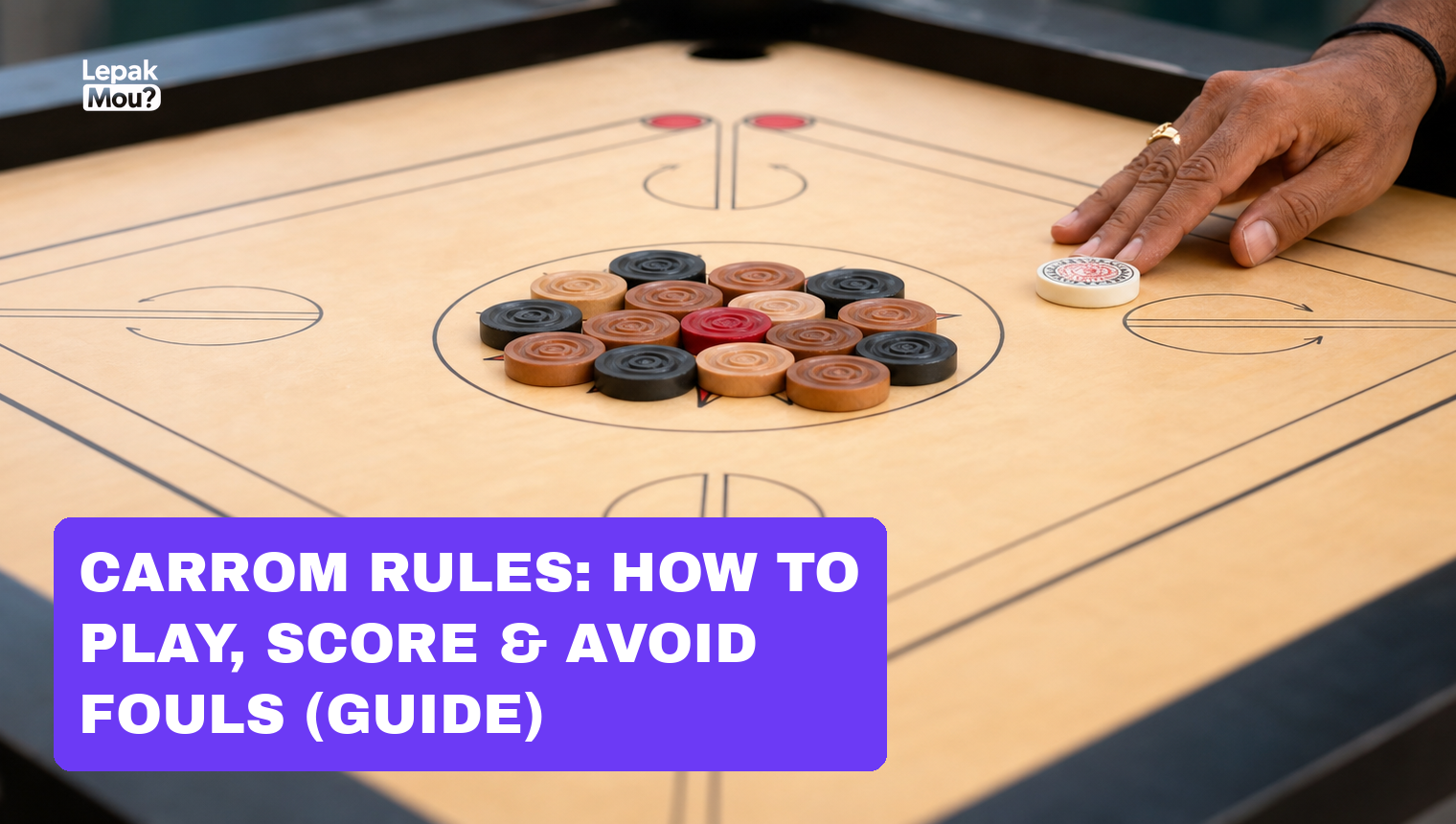
At plenty of Deepavali open houses, the carrom board comes out after the food. Someone dusts it off, sprinkles the powder, and within five minutes the uncles are arguing about thumbing.
“Cannot use thumb!” “Who says cannot?”
Sound familiar? This guide covers the carrom rules you need to settle every one of those arguments.
You get the official tournament version first, then the common house variations, so everyone at the table knows what they agreed to.
Here is the short version. In carrom, you flick a striker to pocket all 9 of your coins plus the red queen before your opponent clears theirs.
The queen only counts once you “cover” it with one of your own coins. Win the board and you score points for whatever your opponent left behind.
Below you will find the setup, a step-by-step guide on how to play carrom, and quick tables for queen situations, scoring and fouls. Everything is written in plain English, not legal numbering.
What Is the Carrom Game?
Carrom is a tabletop “strike and pocket” game where players flick a heavier disc called a striker to knock lighter coins into four corner pockets. It is often called finger billiards, and the first player or team to pocket all their coins plus the covered queen wins.
The carrom game comes from the Indian subcontinent and is still hugely popular across South Asia. In Malaysia it has a competitive scene too.
Persatuan Karom Malaysia organised the 8th World Carrom Championship in Langkawi from 3 to 7 October 2022. Carrom is also an event at the MAKSAK games for civil servants.
At home, though, it is mostly a family game where the trash talk matters as much as the skill. If you prefer screens, our list of the best games to play has you covered, but carrom only needs a board and a few friends.
Competitive play follows the Laws of Carrom set by the International Carrom Federation (ICF). National bodies and regional confederations publish these laws.
Two examples are the version hosted by Indian Carrom’s Laws of Carrom page and the Laws of Carrom as adopted by the European Carrom Confederation (PDF). These are the references used for the “official” rules in this guide.
There are two standard formats:
- Singles: 2 players, sitting opposite each other.
- Doubles: 4 players in two teams, with partners sitting opposite each other.
Carrom Board, Coins & Striker: Standard Equipment
Before you get into the carrom board rules themselves, it helps to know what everything on the board is called. Casual boards vary a lot in size and quality, but the official specs below come from the Laws of Carrom.
| Item | What it is | Official spec |
|---|---|---|
| Board | Square wooden board with a raised wooden frame | Playing surface about 74 cm x 74 cm |
| Pockets | 4 corner holes with nets underneath | 4.45 cm in diameter |
| Baselines | Two parallel lines in front of each player, ending in small circles | Your striker must be placed here |
| Diagonal arrows | Lines pointing from the baselines towards each pocket | Your elbow cannot go beyond these lines |
| Centre circle | Circle in the middle where coins are arranged | The queen sits on the centre spot |
| Coins (carrom men) | 9 white and 9 black wooden discs | About 3.02 to 3.18 cm across, roughly 5 to 5.5 g each |
| Queen | 1 red coin, same size as the others | Placed at the very centre |
| Striker | Larger, heavier disc you flick | Not more than about 4.13 cm across and not more than about 15 g |
| Powder | Fine powder, most commonly boric acid | Used lightly so pieces glide |
Why powder matters: a dry board makes the coins drag and stop short. A light dusting lets the striker slide smoothly and rebound properly off the frame.
Don’t overdo it, though. Too much powder turns the board into an ice rink and you will pocket the striker by accident more often.
That is a foul, which we cover below.
On cost, price comparison site BigGo Malaysia listed boards in October 2026 from RM65 (US$16) for a 47 cm mini board. Most regular boards sat between RM89 and RM250 (US$22 to US$61), while thick plywood or luxury boards reached RM495 to RM550 (US$121 to US$135).
How to Set Up the Carrom Board
The starting arrangement looks like a flower in the centre circle. Here’s how to build it:
- Queen first: Place the red queen on the centre spot.
- Inner ring of 6: Arrange six coins in a circle touching the queen, alternating white and black.
- Outer ring of 12: Place twelve coins around the inner ring, touching it. In the official layout, the white coins form a “Y” shape, and the remaining spaces alternate black and white.
- Count check: You should have 19 coins in total: 9 white, 9 black and 1 queen.
The official laws also say all 19 pieces must sit in a compact round, touching each other, inside the outer circle. At home, most people simply alternate colours in both rings, which works fine as long as nobody “accidentally” lines up three whites facing a pocket.
How to Play Carrom: Step-by-Step for Beginners
If you have never touched a board before, these carrom game rules for beginners take you from the first flick to the end of a board.
- Know the goal: Pocket all 9 of your coins, plus pocket and cover the queen, before your opponent clears theirs.
- Place your striker: Officially, the striker must touch both of your baselines. At the end of a baseline, it must either fully cover the base circle or not touch it at all, and it can never touch the diagonal arrow line.
- Flick, don’t push: Strike with a flick of a finger. Pushing the striker along the board is not a legal shot.
- Stay in your zone: Your hand and arm should not cross the diagonal arrow lines, and you must stay seated without moving into another player’s side of the board.
- Keep shooting while you score: Pocket your own coin and you play again. Miss, and the turn passes.
- Cover the queen: Once you pocket the queen, you must pocket one of your own coins right away to keep it (details below).
- Finish the board: The first player or team to clear all their coins, with the queen covered, wins the board and scores points.
Thumbing vs finger flicking: the official laws say the stroke is made with a finger, and they define “thumbing” separately as a stroke with the thumb. Rules guides read this differently, and carrom.co.uk’s guide allows the thumb for back shots.
Plenty of home games ban the thumb completely because it adds power. Since even the experts word it differently, agree on thumbing before the first break.
The Toss & Choosing Black or White
Before the first board, players toss. Officially, the winner of the toss chooses either to break first or to pick which side of the board to sit on.
The loser gets whichever option is left. One of the simplest carrom board black and white rules to remember is that white always breaks.
Whoever strikes first plays white, and the opponent plays black.
The Break & Turn of Play
The break is the opening shot, and it must disturb the centre formation. Under the official laws, you get three attempts to break.
If all three fail to move the coins, your turn passes to your opponent.
After the break, the continuation rule kicks in. If you pocket one of your own coins, you shoot again.
If you pocket nothing, or only your opponent’s coins, your turn ends. Officially, play passes counter-clockwise, which means to your right.
Worked example: You break and a white drops into the pocket, so you shoot again. On your second shot you miss.
Your opponent (black) now takes their turn from their own baseline.
Carrom Queen Rules: Pocketing and Covering the Red Coin
The red coin causes more fights than anything else on the board, so here are the carrom queen rules in plain terms.
Covering means that after you pocket the queen, you must pocket one of your own coins either in the same shot or on your very next shot. If you manage it, the queen is yours.
If you don’t, the queen goes back to the centre circle and stays in play.
Timing matters: Officially, you can only pocket the queen after you have pocketed at least one of your own coins. If you sink the queen before that, it goes back to the centre and you lose your turn.
Don’t leave it too late: If you pocket your last coin while the queen is still on the board, you lose the board. Your opponent scores 3 points, or just 1 if they are already on 22 or more.
| Situation | What happens |
|---|---|
| You pocket the queen, then pocket your own coin on the next shot | Queen is covered and it’s yours. Keep shooting. |
| You pocket the queen, then miss the cover shot | Queen goes back to the centre. Your turn ends. |
| You pocket the queen and your own coin in the same shot | Queen is covered immediately. Shoot again. |
| You pocket the queen before any of your own coins | Queen goes back to the centre and your turn ends (official rule). |
| You pocket the queen plus only an opponent’s coin | Not covered. Queen returns to the centre and your turn ends. |
| You pocket your last coin while the queen is still on the board | You lose the board. Your opponent scores 3 points (1 if they are on 22 or more). |
House rule watch: plenty of families let you pocket the queen at any time, even as your very first coin. Some also don’t require a cover at all.
Both are fine for a lepak session at home, but neither matches tournament play.
Carrom Scoring: How Points Work
Official carrom scoring is simpler than most people think. Points are only scored by the winner of each board.
- The winner scores 1 point for every opponent coin left on the board.
- The winner adds 3 points for the queen, but only if the winner was the one who covered it.
- The queen bonus stops counting once the winner’s total reaches 22 points or more. From then on, only coins count.
A game is played to 25 points or 8 boards, whichever comes first. If 8 boards are done and nobody has reached 25, the player or team with the higher total wins.
A tie goes to one extra board, per the official laws.
Worked examples:
- You clear the board, your opponent has 4 coins left and you covered the queen: 4 + 3 = 7 points.
- White clears the board, black has 5 coins left and white covered the queen: 5 + 3 = 8 points to white.
- You clear the board, your opponent has 6 coins left but they covered the queen: 6 points to you, with no queen bonus.
- You are already on 23 points and win a board with 2 opponent coins left plus a covered queen. You only add 2 points, because the queen no longer counts at 22 and above.
Carrom Scoring Table at a Glance
| Scoring element | Points | Condition |
|---|---|---|
| Each opponent coin left on board | 1 point each | Counted when you win the board |
| Queen | +3 points | Only if the board winner covered it, and only while their score is below 22 |
| Losing the board | 0 points | Only the board winner scores |
| Game target | 25 points | Or the higher score after 8 boards |
Points Carrom: A Common House Variant
Some groups play a “points” format instead of board scoring. Every coin you pocket carries a fixed value, and the highest total at the end wins.
There is no single standard for the values, and points carrom is not part of the official laws. Treat it as a house rule and agree on the coin values and target score before anyone touches the striker.
Carrom Fouls and Penalties
This is where most games go sideways. Carrom fouls are built around one idea: the “due”.
When you owe a due, one of your pocketed coins goes back on the board, placed by your opponent inside the outer circle. If you haven’t pocketed any coins yet, you owe one and pay it the moment you pocket your first coin.
The official laws split fouls into two types. A technical foul before your first shot costs one coin but you keep your turn, while a foul during play costs one coin and your turn.
| Foul | What it looks like | Penalty |
|---|---|---|
| Pocketing the striker alone | The striker drops into a pocket and nothing else goes in | Pay 1 due and lose your turn |
| Pocketing the striker with your own coin | Your coin and the striker both drop in | Your coin comes back out, plus 1 due, but you keep your turn |
| Pocketing the striker with an opponent’s coin | Their coin and the striker both drop in | Their coin counts as pocketed. You pay 1 due and lose your turn |
| Striker leaving the board | Striker flies off over the frame | Not a foul by itself. You keep your turn only if that shot pocketed your coin or the queen |
| Coin leaving the board | A coin or the queen jumps off the board | It is placed back in the centre circle |
| Touching or disturbing coins | Your fingers or sleeve move any coin outside your stroke | Foul: pay 1 due and lose your turn |
| Wrong striker placement | Striker not touching both baselines, or touching the diagonal arrow line | Foul: pay 1 due and lose your turn |
| Crossing the diagonal arrow | Your elbow or arm goes beyond the arrow line | Foul: pay 1 due and lose your turn |
| Pocketing an opponent’s coin | Your shot sinks only their colour | Not a foul. Their coin stays pocketed (it helps them) and your turn ends |
| Pocketing your last coin before the queen is covered | You clear your coins while the queen is still in play | You lose the board. Your opponent scores 3 points (1 if they are on 22 or more) |
| Pocketing your opponent’s last coin | You sink their final coin for them | You lose the board. They score 1 point per coin you have left, plus 3 if the queen is still on the board and they are below 22 |
Scenario 1: You pocket a white and the striker in the same shot. The white comes back out and you pay one more coin as a due, so that shot costs you two coins.
The upside is that you keep your turn.
Scenario 2: It’s your first turn and you pocket the striker before sinking anything. You owe one due.
Later, when you pocket your first white, it goes straight back to the centre to pay off the debt.
In casual games, people often skip the due and just say “lose turn”. That keeps things fast, but it rewards careless shots.
If you want to improve, play with dues.
Carrom Game Rules for 4 Players (Doubles)
Doubles is perfect for family gatherings, because it gets four people around one board. The carrom game rules for 4 players follow the same core laws with a few team tweaks:
- Seating: partners sit opposite each other and share a colour. The breaking team plays white.
- Turn order: play rotates counter-clockwise around the board, so teams alternate: you, then an opponent, then your partner, then the other opponent.
- Pocketing: a coin you pocket counts for your team. Pocket your colour and you keep shooting as usual.
- Queen: the player who pockets the queen must cover it themselves. Your partner cannot cover it for you on their turn.
- Scoring: the board is won by the team, using the same coins-left plus queen formula, and the same 25-point or 8-board game length.
- No signalling: in official play, partners cannot talk tactics, point or signal during the board. At home this rule is basically ignored, and half the fun is the backseat advice.
A carrom night with another couple also makes a pretty decent budget date, with zero cover charge. For more ideas, see our guide to date ideas in KL.
Official vs House Rules: Carrom Rules in Malaysia
Most carrom rules in Malaysia are passed down at home rather than read from a rulebook. That’s why two families can play “the same game” and still disagree on half the rules.
Here is how the official version compares with what you commonly see locally.
| Topic | Official (ICF laws) | Common Malaysian house rule |
|---|---|---|
| Thumbing | Stroke made with a finger; guides differ on the thumb | Often banned, so you use the index or middle finger only |
| When you can pocket the queen | Only after pocketing one of your own coins | Often allowed at any time |
| Queen bonus | +3, and only counts below 22 points | Counted every board, or played as points carrom |
| Game length | 25 points or 8 boards | A fixed number of boards, “until dinner” |
| Fouls | Strict dues and loss of turn | Usually just “lose turn”, with dues sometimes skipped |
| Breaking attempts | Three attempts | Often unlimited, or just one |
If you plan to enter a tournament, check the organiser’s rule sheet. Persatuan Karom Malaysia hosted an ICF-recognised world championship in 2022, and events like that follow the official laws strictly.
Pro tip: before the first break, take 30 seconds to agree on three things: thumb or no thumb, whether dues apply, and what score you’re playing to. Settle those and the open house stays peaceful, at least until the last board.
Beginner Tips to Win More Boards
Knowing the rules is half the battle. These habits help you use them to your advantage:
- Aim with the centre of the striker: Line up the middle of the striker with the point on the coin you want to hit. Off-centre contact sends the striker spinning towards pockets, which risks the striker-pocket foul.
- Learn the cut shot: Hit a coin slightly on its side to send it at an angle towards a corner. Most coins near the frame are pocketed this way, not with straight shots.
- Leave the queen until you can cover it: Only go for the queen when one of your coins is sitting near a pocket for an easy cover. A missed cover just hands the queen back to the board.
- Play defence: If you have no good shot, park a coin in front of a pocket your opponent needs, or push their coins away from easy angles. Pocketing their coin isn’t a foul, but it does end your turn and helps them.
- Control your power: Most beginner fouls come from hitting too hard. A medium-strength flick is enough for most shots and keeps the striker on the board.
- Powder lightly: A thin layer gives a predictable glide. Re-powder only when the board starts feeling sticky.
School holidays are a good time to teach the kids. Carrom builds aim and patience without needing a screen.
Where to Play or Buy a Carrom Board in Malaysia
You can find carrom boards at sports shops and on online marketplaces like Shopee and Lazada. Check the board size before you buy, because some cheaper listings are mini boards well under the official 74 cm playing surface.
A carrom board also makes a solid present for families who like to lepak at home, so add it to your Christmas gift ideas list. For a place to play, family gatherings and open houses are the classic spots.
If your crowd prefers cards or tiles, our guides to card games and how to play mahjong cover the other open house favourites. For a night out instead, try a board game cafe in KL, bowling, pickleball or karaoke.
Settle the Rules, Then Play
That’s everything you need to run a proper board, from the break to the final cover. Print out the scoring and fouls tables and stick them under the board.
The next time someone shouts “cannot use thumb!”, you’ll know exactly where you all stand. Then just play lah.