
How to Play Mahjong: A Beginner’s Guide to Malaysian Rules
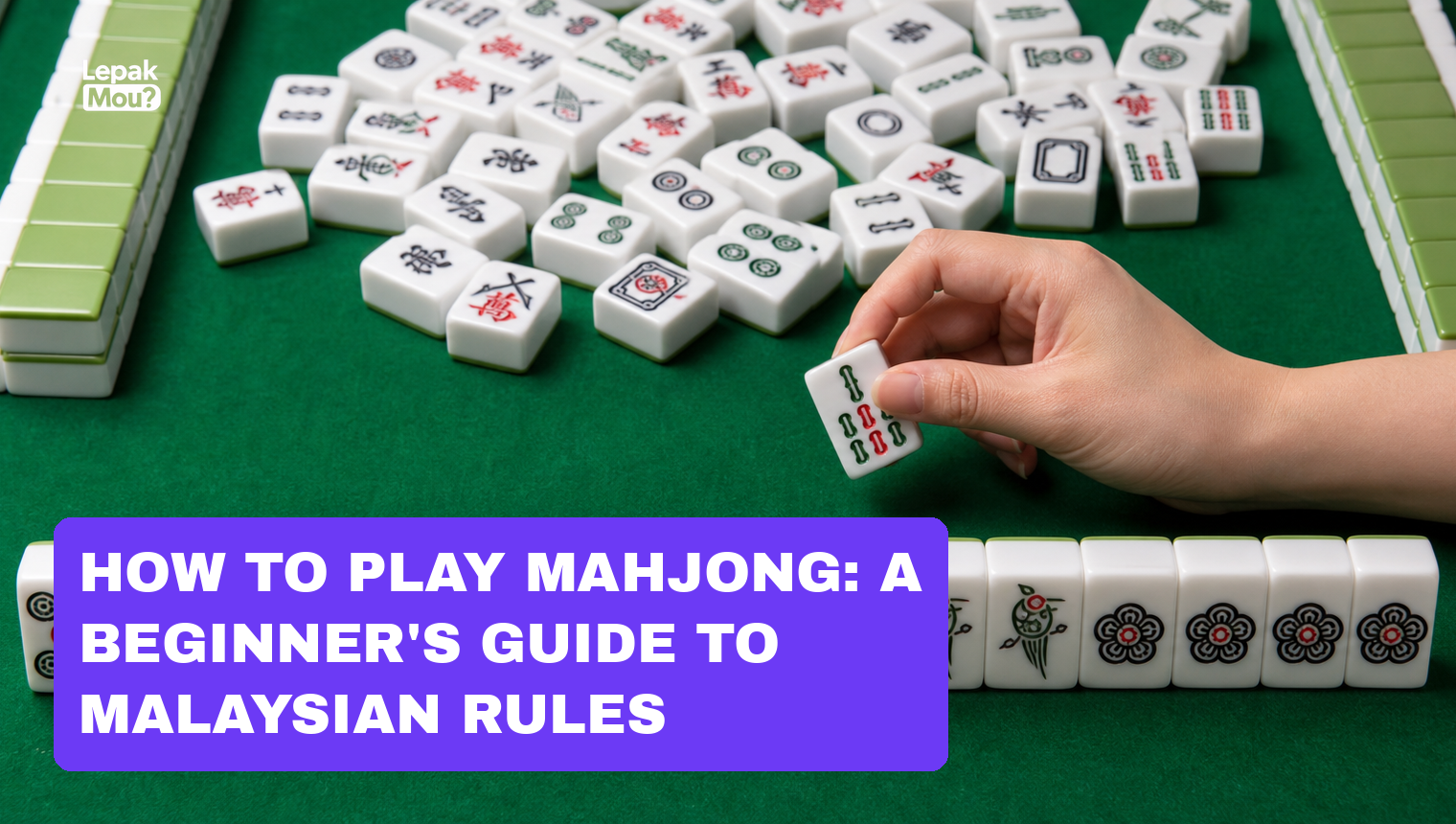
It is the second day of Chinese New Year at ah ma’s house. The tiles are clattering, someone shouts “pong!”, and everybody else groans.
Meanwhile you are holding a cup of tea and nodding along with no idea what just happened.
This guide teaches you how to play mahjong so you can actually sit down at that table. By the end you will recognise every tile, play a full hand, declare a win and count basic tai.
One important note: this is the Chinese and Malaysian style of the game. Several top Google results teach American Mahjong, which uses jokers and a yearly card, so it will not match what your family plays.
What Is Mahjong? The Quick Answer
Mahjong is a tile game, usually for four players, where you draw and discard tiles to build a winning hand. The first player to complete a valid 14-tile hand, made of four sets plus one pair, calls a win and scores points.
The game took shape in 19th-century China and spread across Asia with Chinese communities. In Malaysia it is a fixture at CNY, weddings and weekend family gatherings.
Regional styles share the same core, but they differ mainly in how many tiles they use and how they score.
Mahjong Tiles Explained: What’s in a Set
Before learning any mahjong rules, get to know the tiles. A Malaysian or Singapore set usually has 148 tiles.
Here is how they break down.
| Tile group | Tiles | Count | Running total |
|---|---|---|---|
| Dots (tong) | 1 to 9, four copies each | 36 | 36 |
| Bamboo (sok) | 1 to 9, four copies each | 36 | 72 |
| Characters (man / wan) | 1 to 9, four copies each | 36 | 108 |
| Winds | East, South, West, North, four each | 16 | 124 |
| Dragons | Red, Green, White, four each | 12 | 136 |
| Flowers and Seasons | Four flowers, four seasons | 8 | 144 |
| Animals (Malaysia/Singapore) | Cat, rat, rooster, centipede | 4 | 148 |
Two classic beginner traps: the 1 Bamboo usually shows a bird (often a peacock or sparrow), not a stick. And the White Dragon is often a blank tile or one with a simple blue frame.
Do not mistake it for a spare.
The Three Suits: Dots, Bamboo and Characters
The three suits are the backbone of the game. Each runs from 1 to 9, and there are four copies of every tile.
- Dots (circles, tong): show circles. Count them and you have the number.
- Bamboo (sticks, sok): show bamboo sticks. Easy to count, except the bird on the 1.
- Characters (wan, man): show a Chinese numeral on top and the character 萬 (ten thousand) below.
The character suit trips up most beginners, so here is a quick lookup for the top numeral:
| 一 | 二 | 三 | 四 | 五 | 六 | 七 | 八 | 九 |
|---|---|---|---|---|---|---|---|---|
| 1 | 2 | 3 | 4 | 5 | 6 | 7 | 8 | 9 |
When you get your tiles, sort them by suit and then by number from left to right, with honours at one end. A sorted hand makes it much easier to spot what you need.
Honour Tiles: Winds and Dragons
Honour tiles have no numbers. The four winds are East (東), South (南), West (西) and North (北).
The three dragons are Red (中), Green (發) and White. There are four of each.
Because they have no numbers, honour tiles can only form pongs or kongs, never runs. They also matter for scoring.
A pong of any dragon, your own seat wind or the current round wind usually earns extra tai, which we cover in the scoring section below.
Flowers, Seasons and Animal Tiles
Bonus tiles are not part of your hand. When you draw one, place it face-up beside you straight away and draw a replacement from the back end of the wall.
Each flower and season is numbered 1 to 4, and a bonus tile matching your seat number often adds a tai.
Malaysian and Singapore sets add four animal tiles: cat, rat, rooster and centipede. Many tables reward the classic pairings “cat catches rat” and “rooster eats centipede” if you collect both of a pair.
Buying a set? Check whether it has 144 or 148 tiles before you pay.
Chinatown shops along Petaling Street in KL are a traditional place to look, alongside the usual online marketplaces.
The Goal: What a Winning Hand Looks Like
Your aim is to build four sets plus one pair. There are three kinds of set:
- Chow: three tiles in a row of the same suit, like 3-4-5 Dots. Honours cannot form a chow.
- Pong: three identical tiles, like three Red Dragons or three 7 Bamboo.
- Kong: four identical tiles, like four East Winds.
The pair is called the “eye”, for example two 9 Characters. Here is one complete winning hand of 14 tiles:
2-3-4 Dots | 6-7-8 Bamboo | 5-5-5 Characters | Red-Red-Red Dragons | 9-9 Bamboo (eye)
A kong still counts as one set even though it uses four tiles. That is why you draw an extra tile after making one, so your hand still adds up.
How to Set Up a Game of Mahjong
This is how to play mahjong with 4 players, from a pile of tiles to the first discard.
- Wash the tiles: Turn everything face-down and everyone mixes them on the table with both hands. Noisy, yes, but that is part of the fun.
- Build the walls: Each player builds a wall two tiles high in front of them, and the four walls are pushed together into a square. With 144 tiles that is 18 stacks each, while with 148 tiles two players build 19 stacks and two build 18.
- Pick the dealer: Roll the dice, and the highest roller (or the player the total points to) becomes the dealer in the East seat. South, West and North follow counter-clockwise.
- Break the wall: The dealer rolls again. Count around the players to find which wall to break, then count that many stacks in from the right to find the starting point.
- Deal: Starting with East, each player takes four tiles at a time for three rounds, then one more. East takes one extra, ending with 14 tiles while everyone else has 13.
- Replace bonus tiles: Starting with East, everyone sets aside flowers and animals and draws replacements.
House rule check: wall sizes, how the dealer rotates and how you break the wall vary between families. Ask before the first hand.
How to Play Mahjong: Turn by Turn
Play moves counter-clockwise. East starts by discarding one tile, since they already hold 14.
After that, every turn follows the same basic rhythm.
Drawing and Discarding
- Draw one tile from the wall.
- If it is a flower, season or animal, set it aside face-up and draw a replacement from the end of the wall.
- Decide what you do not need.
- Discard one tile face-up in the centre and say its name aloud, like “five dots”.
This draw-one, discard-one rhythm keeps your hand at 13 tiles. Keep the discards in neat rows rather than a messy pile.
Everyone uses the discard area to read what is still out there, so tidy discards make the game fairer.
Calling Chow, Pong and Kong
You do not always have to draw from the wall. You can claim the latest discard if it completes a set for you.
- Chow: only from the player on your left (the one who plays just before you). Say “chow”, take the tile and show the run face-up.
- Pong: from anyone, even out of turn. Say “pong”, take the tile and expose the three.
- Kong: from anyone, if you hold three and someone discards the fourth. Expose all four and draw a replacement from the end of the wall.
After any claim, you discard one tile and play continues from your right. Exposed sets stay face-up for the rest of the hand.
If you draw all four identical tiles yourself, that is a concealed kong. You usually lay it down with two tiles face-down so it stays partly hidden, and it often scores better than an exposed kong.
If you have already exposed a pong and draw the fourth tile, you can add it to make an exposed kong.
Who Gets the Tile? Claim Priority
Sometimes two players want the same discard. Use this ladder:
- Winning call (hu) beats everything.
- Pong or kong beats chow.
- Chow comes last.
If two players call a win on the same tile, the usual rule is that the player next in turn order after the discarder wins. Some houses allow both to win, so settle this before you start.
A quick example turn: You draw 6 Bamboo. It fits next to your 7-8 Bamboo, so you keep it and discard a lonely North Wind.
North is an honour tile, so nobody can chow it. But the player opposite you holds two North Winds, shouts “pong!” and exposes three Norths.
They then discard a 1 Dot, and play continues from their right. That is how quickly the turn order can jump.
How to Declare a Win (and What Happens if Nobody Wins)
There are two ways to win:
- Self-drawn (zimo): you draw the winning tile from the wall yourself. All three opponents usually pay.
- Off a discard: you claim someone’s discard to finish your hand. The discarder usually pays more, sometimes the whole amount.
Say “hu” (or “sik wu” in Cantonese) and lay your full hand face-up for everyone to check. Many Malaysian tables have a minimum, like 1 tai, before you can declare.
If the wall runs out and nobody wins, the hand is a draw. The dealer typically stays on for the next hand.
Mahjong Scoring for Beginners: Counting Tai
Mahjong scoring is where most beginners get lost, so keep it simple. Malaysian tables usually count tai (fan in Cantonese).
Each special feature of your hand adds tai. Most tables set a minimum to win, often 1 tai, and a cap, often 5 tai, so scores do not get out of hand.
The table below shows common values. Your table may differ, so treat this as a starting point.
| Hand or feature | What it means | Common tai |
|---|---|---|
| Ping hu (all chows) | Four chows plus a non-scoring pair, often no bonus tiles | 1 to 4 |
| Dui dui hu (all pongs) | Four pongs or kongs plus a pair | 2 to 3 |
| Half flush | One suit plus honour tiles only | 2 |
| Full flush | One suit only, no honours | 4 (often the cap) |
| Dragon pong | Pong or kong of any dragon | 1 each |
| Seat wind pong | Pong of your own wind | 1 |
| Round wind pong | Pong of the current round’s wind | 1 |
| Matching flower or season | Bonus tile number matches your seat | 1 each |
| Animal tile | Each animal collected | 1 each |
| Self-drawn | Winning tile drawn from the wall | 0 to 1 |
Worked example: You are sitting South, and your winning hand is:
- Pong of Red Dragons
- Pong of South Wind
- 2-3-4 Bamboo and 6-7-8 Bamboo
- Pair of 9 Bamboo
- You also have Flower 2, which matches South (seat 2)
Count it up:
- Half flush (Bamboo plus honours): 2 tai
- Red Dragon pong: 1 tai
- South Wind pong (your seat wind): 1 tai
- Matching flower: 1 tai
Total: 2 + 1 + 1 + 1 = 5 tai, which hits the common cap. Nice hand.
For your first few games, use chips or a simple points sheet. Write each player’s name at the top and tally tai per hand.
Much easier than arguing at the end.
Malaysian Mahjong: How It Differs From Other Styles
Malaysian mahjong sits close to the Singapore style, and both grew out of the Cantonese game. Here is how the main styles compare.
| Feature | Malaysian / Singapore | Hong Kong / Cantonese | American |
|---|---|---|---|
| Tile count | 148 | 144 | 152 |
| Animal tiles | Yes (4) | No | No |
| Jokers | No | No | Yes (8) |
| Scoring unit | Tai | Fan | Points printed on the card |
| How you build a hand | Free, any valid sets | Free, any valid sets | Must match a hand on the yearly NMJL card |
If you are learning how to play mahjong in Singapore, the rules above will feel very familiar. Hong Kong style is basically the same game minus the animals, with fan instead of tai.
American Mahjong, governed by the National Mah Jongg League, is a different game altogether, so ignore those tutorials.
Some Malaysian and Singapore tables also use “bite” or instant-payout conventions. For example, when you collect a matching animal pair or make a concealed kong, other players pay out points on the spot rather than waiting for the hand to end.
This is entirely house-rule territory, so ask first.
You might also see lami mahjong (sometimes called rummy mahjong) on mobile apps. It is a simplified, rummy-style game played with mahjong tiles, where you form runs and groups to clear your hand.
Rules change from app to app, so read the in-app guide before you play.
How to Play 3 Player Mahjong
One cousin went to tapau supper and now you are three? No problem, because Malaysia has its own 3 player mahjong game.
Malaysian 3-player mahjong uses 84 tiles instead of 148. According to SAYS and Sloperama, these are the main changes:
- Dots only: the Bamboo and Character suits are taken out, leaving 36 Dot tiles.
- No North seat: players sit East, South and West, and some tables remove the North Wind tiles too.
- Fly tiles: four Fly tiles work as wildcards in any three-tile set, but they cannot be used to make a kong.
- Bonus tiles stay: flowers, seasons, faces and animals are still set aside and replaced.
- Bigger minimum: you need at least 5 fan to declare a win.
With only one suit, hands come together faster and big hands show up more often. Expect higher scores per hand.
House rule check: some tables use different minimums or Fly rules. Agree before the first wash, because changing mid-game confirm got argument.
Playing Mahjong With 2 Players or by Yourself
With two players, the simplest option is that each person plays two hands at a full table. Some groups instead use a reduced set with only one suit plus honours, which keeps the game moving.
Playing alone? Mahjong apps with computer opponents are the best way to practise turn order and scoring without pressure.
Look for one that offers Hong Kong or Singapore rules. If you enjoy relaxed tile and puzzle play, some of the best indie games scratch a similar itch.
Just note that Mahjong Solitaire (the tile-matching game in titles like Microsoft Mahjong or Mahjong Journey) is a completely different game. You match pairs to clear a board.
Fun, but it will not teach you real mahjong.
Want to practise with a group first? Board game cafes in KL like Bored. in Damansara Jaya even have a mahjong table.
Beginner Tips to Win More Hands
These mahjong for beginners tips will help you stop feeding everyone else’s hands.
- Dump isolated honours early: A single West Wind that is not your seat or round wind is hard to use. Get rid of it in the first few turns.
- Keep dragons a bit longer: A pair of Green Dragons is worth holding, since one more makes a scoring pong.
- Prefer connected tiles: 4-5 Dots can become a chow with a 3 or a 6. Edge tiles like 1-2 only wait for a 3.
- Watch your left: If the player on your left keeps throwing Bamboo, do not count on chowing Bamboo from them later.
- Count visible tiles: If three 6 Dots are already discarded or exposed, your wait on 6 Dots is almost dead. Switch your plan.
- Do not chase big hands yet: A quick 1-tai win beats a full flush that never finishes.
- Be careful late in the hand: When the wall runs low, discard tiles others have already thrown. They are safer.
Mahjong Etiquette and Playing Responsibly
Good table manners keep the game friendly:
- Do not touch the wall or peek at tiles out of turn.
- Announce your calls clearly. A mumbled “pong” after the next player has drawn usually does not count.
- Agree house rules on tai caps, payouts and 3-player tweaks before the first hand.
- Keep your hand hidden and your discards neat.
On money: social mahjong with small stakes is common at gatherings, but gambling outside licensed operators is restricted under Malaysian law, notably the Common Gaming Houses Act 1953. You can read the legislation through the Attorney General’s Chambers of Malaysia.
Many Muslim Malaysians also do not play for money for religious reasons, so be mindful of who is at the table.
The easiest fix is to play for chips, points or snacks. Keropok and kuaci work great lah.
If gaming ever stops feeling fun or starts causing stress, talk to someone you trust or reach out to Befrienders Malaysia for confidential emotional support.
Waiting for a seat at the table? Our guides to card games, poker hand rankings and carrom rules cover the other game-night classics.