
Poker Hand Rankings: Full Chart, Cheat Sheet & What Beats What
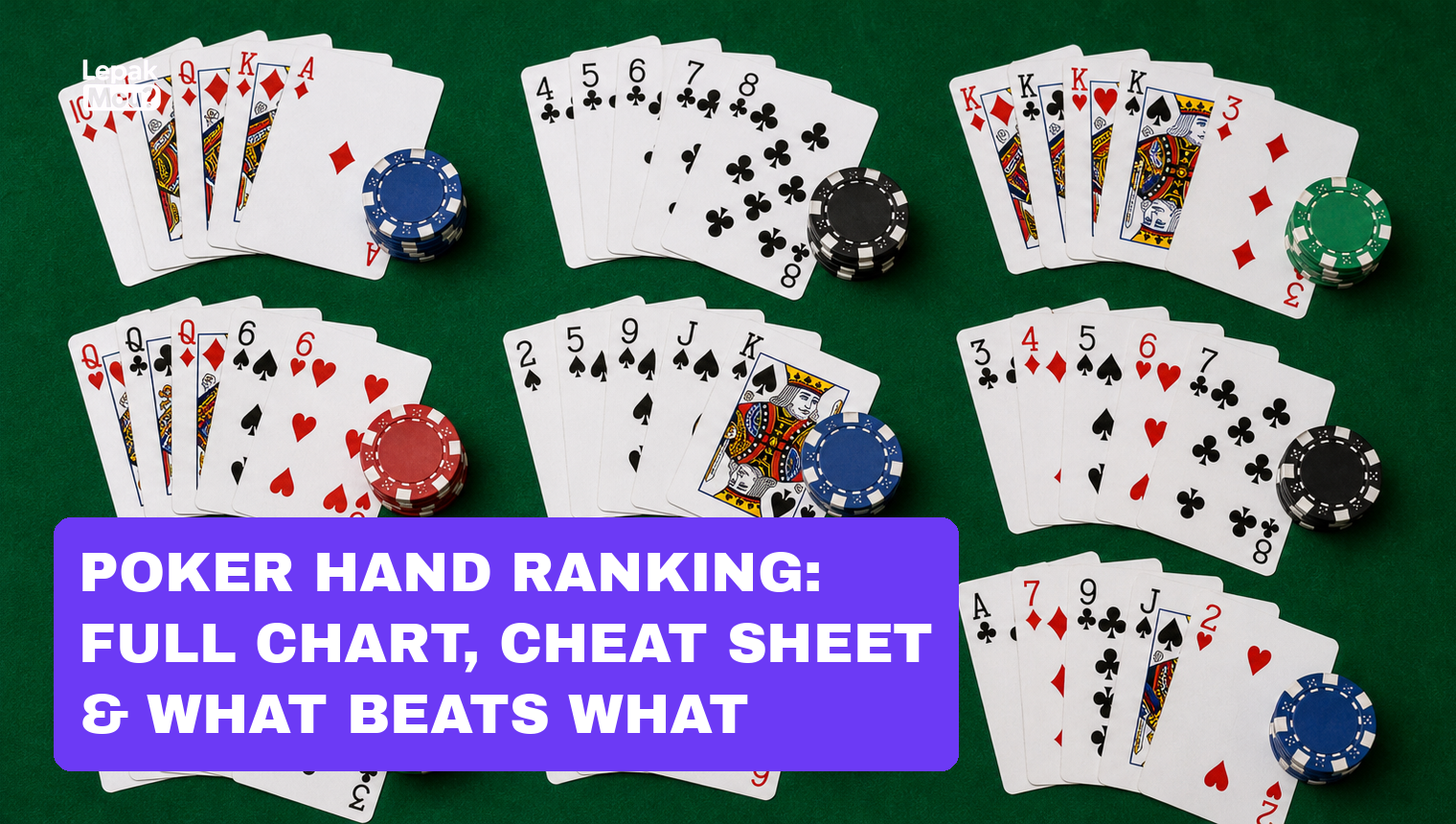
The poker hand ranking has 10 hands. From best to worst, they are Royal Flush, Straight Flush, Four of a Kind, Full House, Flush, Straight, Three of a Kind, Two Pair, One Pair and High Card.
That order is all you need to know before the first deal.
This guide is for people learning poker for a friends’ game night, a Texas Hold’em scene in a movie, or a free mobile app. It is not for people gambling real money.
You’ll get a quick chart, a plain-English explanation of every hand, tie-breaker rules, how rare each hand is in 5-card and 7-card play, and a printable cheat sheet. There’s also a comparison with Big Two (Choh Dai Di) for everyone who grew up playing it at Chinese New Year.
Poker Hand Rankings Chart (Quick Cheat Sheet)
Here is the full poker hand rankings chart, ordered from strongest to weakest. Screenshot it, keep it open on your phone, or scroll down to the printable version.
| Rank | Hand | Example | What It Means |
|---|---|---|---|
| 1 | Royal Flush | A♠ K♠ Q♠ J♠ 10♠ | A to 10, all the same suit |
| 2 | Straight Flush | 9♥ 8♥ 7♥ 6♥ 5♥ | Five in a row, same suit |
| 3 | Four of a Kind | K♣ K♦ K♥ K♠ 7♦ | Four cards of the same rank |
| 4 | Full House | Q♠ Q♥ Q♦ 4♣ 4♠ | Three of a kind plus a pair |
| 5 | Flush | A♦ J♦ 8♦ 4♦ 2♦ | Five of the same suit, not in sequence |
| 6 | Straight | J♣ 10♦ 9♠ 8♥ 7♣ | Five in a row, mixed suits |
| 7 | Three of a Kind | 8♠ 8♦ 8♣ K♥ 3♠ | Three cards of the same rank |
| 8 | Two Pair | J♥ J♣ 5♦ 5♠ A♣ | Two different pairs |
| 9 | One Pair | 10♠ 10♥ A♦ 7♣ 2♠ | Two cards of the same rank |
| 10 | High Card | A♣ Q♦ 9♠ 6♥ 3♣ | No combination, highest card plays |
The one rule to remember: a hand higher on this chart always beats any hand lower on the chart, no matter the card values. A tiny 2-3-4-5-6 straight still beats three aces.
Poker Hands Ranked: Every Hand Explained
Each hand below follows the same format: what makes it, an example, one common mistake, and how many 5-card combinations exist in a standard 52-card deck. The headings run from best to worst, so the list itself doubles as the ranking.
1. Royal Flush
A-K-Q-J-10, all in the same suit. Example: A♥ K♥ Q♥ J♥ 10♥.
This is the highest-ranking hand in poker. Technically it’s just the best possible straight flush, but it gets its own name because it’s so rare.
There are only 4 royal flushes in the deck, one per suit. If two players somehow both have one, they split the pot, because suits don’t rank in standard poker.
2. Straight Flush
Five consecutive cards of the same suit. Example: 9♥ 8♥ 7♥ 6♥ 5♥.
Between two straight flushes, the one with the higher top card wins. The lowest possible is 5♣ 4♣ 3♣ 2♣ A♣, nicknamed the “steel wheel”, where the ace plays low.
There are 36 combinations if you exclude royal flushes.
3. Four of a Kind (Quads)
Four cards of the same rank plus one extra card. Example: K♣ K♦ K♥ K♠ 7♦.
Higher quads beat lower quads. That extra card is called a kicker (the highest unpaired card, used to break ties).
In Texas Hold’em, if all four sevens are on the shared board, everyone has quads, so the best kicker wins. There are 624 combinations.
4. Full House
Three of a kind plus a pair. Example: Q♠ Q♥ Q♦ 4♣ 4♠, read out loud as “queens full of fours”.
For ties, the three-of-a-kind part decides first, then the pair. So 3-3-3-A-A beats 2-2-2-K-K, and A-A-A-2-2 beats K-K-K-Q-Q.
The trio always matters more than the pair. There are 3,744 combinations.
5. Flush
Any five cards of the same suit that are not in sequence. Example: A♦ J♦ 8♦ 4♦ 2♦.
When two flushes meet, compare the highest card, then the next highest, and so on down the line. Common mistake: thinking an ace-high flush beats a full house.
It doesn’t. A full house is higher on the chart, full stop.
There are 5,108 combinations.
6. Straight
Five consecutive cards of mixed suits. Example: J♣ 10♦ 9♠ 8♥ 7♣, called a “jack-high straight”.
The ace can play high (A-K-Q-J-10) or low (5-4-3-2-A, known as “the wheel”), but a straight can never wrap around. Q-K-A-2-3 is not a straight, no matter how hard your friend argues.
There are 10,200 combinations.
7. Three of a Kind
Three cards of the same rank plus two unrelated cards. Example: 8♠ 8♦ 8♣ K♥ 3♠.
In Hold’em you’ll hear two names. A set is a pocket pair plus one matching card on the board, and trips is one card in your hand plus a pair on the board.
Different names, same hand rank. There are 54,912 combinations.
8. Two Pair
Two different pairs plus a kicker. Example: J♥ J♣ 5♦ 5♠ A♣.
For ties, compare the higher pair first, then the lower pair, then the kicker. So J♥ J♣ 5♦ 5♠ A♣ beats J♦ J♠ 5♥ 5♣ 9♦, because both have jacks and fives, and the ace kicker beats the nine.
There are 123,552 combinations.
9. One Pair
Two cards of the same rank plus three kickers. Example: 10♠ 10♥ A♦ 7♣ 2♠.
This is the hand you’ll see most often outside of high card, appearing in roughly 42.3% of 5-card deals. A higher pair wins, and if the pairs match, the kickers decide in order.
There are 1,098,240 combinations.
10. High Card
No combination at all, so the highest card plays. Example: A♣ Q♦ 9♠ 6♥ 3♣ is “ace-high”.
If two players have the same top card, compare the second card, then the third, and so on. It shows up in about 50.1% of 5-card deals.
There are 1,302,540 combinations.
What Beats What in Poker: Settling Common Arguments
If your cousins are arguing over whether two pair beats a pair of aces at the CNY card table, here’s the answer. Quick yes/no rulings for the classic disputes:
- Does a flush beat a straight? Yes. A flush is rarer, with 5,108 combinations against 10,200 straights.
- Does a full house beat a flush? Yes. There are 3,744 full houses against 5,108 flushes, so the full house ranks higher.
- Does two pair beat a pair of aces? Yes, any two pair beats any one pair, so 3-3-2-2 still beats A-A.
- Does a straight beat three of a kind? Yes. Straights are rarer in 5-card poker, so they rank higher.
- Does an ace-high flush beat a low full house? No. Even 2-2-2-3-3 beats A♦ K♦ Q♦ J♦ 9♦, because category comes first and card values second.
- Does four of a kind beat a full house? Yes, every time.
- Does a straight flush beat four of a kind? Yes. Only a higher straight flush or a royal flush beats it.
The logic behind all of this is simple. The rarer the hand, the higher it ranks.
You can check the actual numbers in the table below.
How Ties Are Broken: Kickers and Split Pots
Most arguments at game night aren’t about which category wins. They’re about two people holding the “same” hand.
The rules are actually very clean:
- Compare the hand category first: Flush beats straight, two pair beats one pair, and so on.
- If the category is the same, compare the rank within it: A pair of kings beats a pair of queens. A queen-high straight beats a jack-high straight.
- If that’s still tied, compare kickers in order until one player has a higher card.
One important point: only five cards ever count. Even in Texas Hold’em, where you can see seven cards, your sixth and seventh cards never break a tie.
Example 1 (the kicker wins): Player A has A♠ A♦ K♣ 9♥ 4♠. Player B has A♥ A♣ Q♦ J♠ 10♣.
Both have a pair of aces, so we move to the kickers. Player A’s king beats Player B’s queen, and Player A takes it.
Player B’s jack and ten don’t matter, because the first kicker already decided it.
Example 2 (the split pot): In Hold’em, the five community cards are A♠ K♠ Q♦ J♣ 10♥. That’s already an ace-high straight on the board.
Player A holds 3♦ 3♣ and Player B holds 7♥ 2♠. Neither hole card improves the straight, so both players “play the board” and the pot is split equally.
And the most important tie rule of all: suits never break ties in standard poker. A spade flush is not better than a heart flush with the same cards.
Texas Poker Ranking: How Hand Rankings Work in Hold’em
Good news for anyone learning Texas Hold’em: the texas poker ranking is exactly the same as the standard chart above. Nothing changes in the order.
What changes is how you build your hand.
In Hold’em, each player gets 2 private cards (called hole cards), and 5 shared community cards are dealt face up on the table (the board). Your hand is the best five-card combination you can make from those seven cards.
You can use both hole cards, one, or even none.
Here’s where beginners trip up. Say you hold J♦ 9♣, and the board finishes 10♠ 8♥ 7♣ J♠ 2♦.
| Your Hole Cards | The Board | What You Think You Have | Your Actual Best Hand |
|---|---|---|---|
| J♦ 9♣ | 10♠ 8♥ 7♣ J♠ 2♦ | Pair of jacks | Jack-high straight: J♦ 10♠ 9♣ 8♥ 7♣ |
Plenty of new players spot the pair of jacks and stop looking. But the J, 10, 9, 8 and 7 line up into a straight, which is three steps higher on the chart.
So always scan the full seven cards for flushes and straights before announcing your hand.
Playing the board means your best five cards are all community cards, like in the split-pot example earlier. When that happens, you can’t do better than anyone else who also plays the board.
How Rare Is Each Poker Hand?
There are 2,598,960 possible 5-card poker hands from a standard 52-card deck. That’s where the poker hands ranking comes from: the rarer the hand, the higher it sits.
The 7-card column shows roughly how often each hand appears as your best five in Hold’em-style games. Figures follow the standard calculations in Wikipedia’s List of Poker Hands.
| Hand | 5-Card Combinations | 5-Card Probability | 7-Card (Hold’em) Probability |
|---|---|---|---|
| Royal Flush | 4 | 0.000154% | ~0.0032% |
| Straight Flush | 36 | 0.00139% | ~0.028% |
| Four of a Kind | 624 | 0.024% | ~0.17% |
| Full House | 3,744 | 0.144% | ~2.6% |
| Flush | 5,108 | 0.197% | ~3.0% |
| Straight | 10,200 | 0.392% | ~4.6% |
| Three of a Kind | 54,912 | 2.11% | ~4.8% |
| Two Pair | 123,552 | 4.75% | ~23.5% |
| One Pair | 1,098,240 | 42.3% | ~43.8% |
| High Card | 1,302,540 | 50.1% | ~17.4% |
Interesting detail: with seven cards to choose from, you are more likely to end up with two pair (about 23.5%) than with no pair at all (about 17.4%). The ranking still follows the 5-card maths, which is why the chart never changes between games.
Does Suit Matter in Poker Hand Rankings?
No. In standard poker, all four suits are equal, and two identical hands in different suits split the pot.
A K♠ Q♠ J♠ 9♠ flush is exactly as strong as A♥ K♥ Q♥ J♥ 9♥.
Some home games use a suit order as a house rule, usually to decide who deals first or who gets an odd chip when splitting. If your group plays this way, agree on it before the first hand so nobody argues later.
If you grew up on Big Two, though, this “suits don’t matter” rule can feel strange. More on that below.
Omaha and Other Poker Variants: Are Rankings Different?
Omaha uses the same poker hand ranking, but with one strict rule. You get 4 hole cards and must use exactly 2 of them plus exactly 3 from the board.
Hold’em players get caught by this all the time. Say the board shows K♥ 9♥ 6♥ 3♥ Q♣ and you hold A♥ J♠ 8♦ 4♣.
In Hold’em that’s an ace-high flush. In Omaha it’s no flush at all, because you only have one heart and must use two hole cards.
Short Deck (6+ Hold’em) removes all cards from 2 to 5. With fewer cards of each suit, flushes become rarer, so a flush beats a full house in this variant.
Lowball and Hi-Lo games flip things around. In lowball the lowest hand wins, and in Hi-Lo the pot is split between the best high hand and the best qualifying low hand.
Check the rules before playing any of these.
Poker vs Big Two (Choh Dai Di): What’s Different?
Many Malaysians already know half of poker without realising it. If you’ve spent Chinese New Year slamming down cards in Big Two (also called Choh Dai Di), the five-card combos will look familiar.
But some key rules are different, and mixing them up is the fastest way to start an argument at the table.
| Feature | Poker | Big Two (Choh Dai Di) |
|---|---|---|
| Highest single card | Ace | 2 |
| Do suits rank? | No, all suits equal | Yes, commonly diamonds < clubs < hearts < spades |
| Five-card combos | Straight, flush, full house, four of a kind, straight flush, plus two pair and three of a kind with kickers | Straight, flush, full house, four of a kind plus one card, straight flush |
| Two pair as a five-card hand | Yes | No |
| Goal | Have the best five-card hand | Be first to get rid of all your cards |
The good part is the five-card order from straight up to straight flush works the same way in both games, so Big Two players already have a head start. Just remember that in poker the ace is king (well, higher than the king), and spades are not special.
House rules for Big Two vary from family to family, so your cousin’s version might differ a bit from what’s shown here.
Prefer tiles to cards? Here is how to play mahjong the Malaysian way, or learn the carrom rules for a break from both.
Printable Poker Hand Rankings Cheat Sheet
Want a poker cheat sheet for the table? This compact version is designed to fit on one phone screen or half an A4 page.
Print it, screenshot it to your camera roll, or laminate it so nobody spills teh tarik on it during game night.
| # | Hand | Example |
|---|---|---|
| 1 | Royal Flush | A♠ K♠ Q♠ J♠ 10♠ |
| 2 | Straight Flush | 9♥ 8♥ 7♥ 6♥ 5♥ |
| 3 | Four of a Kind | K♣ K♦ K♥ K♠ 7♦ |
| 4 | Full House | Q♠ Q♥ Q♦ 4♣ 4♠ |
| 5 | Flush | A♦ J♦ 8♦ 4♦ 2♦ |
| 6 | Straight | J♣ 10♦ 9♠ 8♥ 7♣ |
| 7 | Three of a Kind | 8♠ 8♦ 8♣ K♥ 3♠ |
| 8 | Two Pair | J♥ J♣ 5♦ 5♠ A♣ |
| 9 | One Pair | 10♠ 10♥ A♦ 7♣ 2♠ |
| 10 | High Card | A♣ Q♦ 9♠ 6♥ 3♣ |
Remember: higher on the list always wins. Suits never break ties.
Only your best five cards count.
Playing Poker in Malaysia: Keep It Social and Legal
Now the serious part. Gambling in Malaysia is tightly regulated.
Running or playing in unlicensed gaming is an offence under laws such as the Common Gaming Houses Act 1953 and the Betting Act 1953. You can read the full text of federal acts through the Attorney General’s Chambers of Malaysia.
The country has only one licensed casino, and Muslims are prohibited from gambling under Islamic law and state Syariah enactments.
Unlicensed online poker sites are also illegal, and they come with real risks to your money and personal data.
So keep it social lah. Play for chips, matchsticks, sweets or bragging rights.
Need a bigger table? Try one of the board game cafes in KL.
Free-play poker apps with no cash-out are another easy way to practise reading hands. Prefer video games?
See our pick of the best games of 2026. The best game nights are about the company, the snacks and the trash talk anyway.
Keep it healthy too. Set a time limit, take breaks, and if card games start feeling like a pressure instead of fun, talk to someone.
Befrienders Kuala Lumpur offers free, confidential emotional support.