
Card Games: 10 Malaysian Favourites From Big 2 to Ban Luck
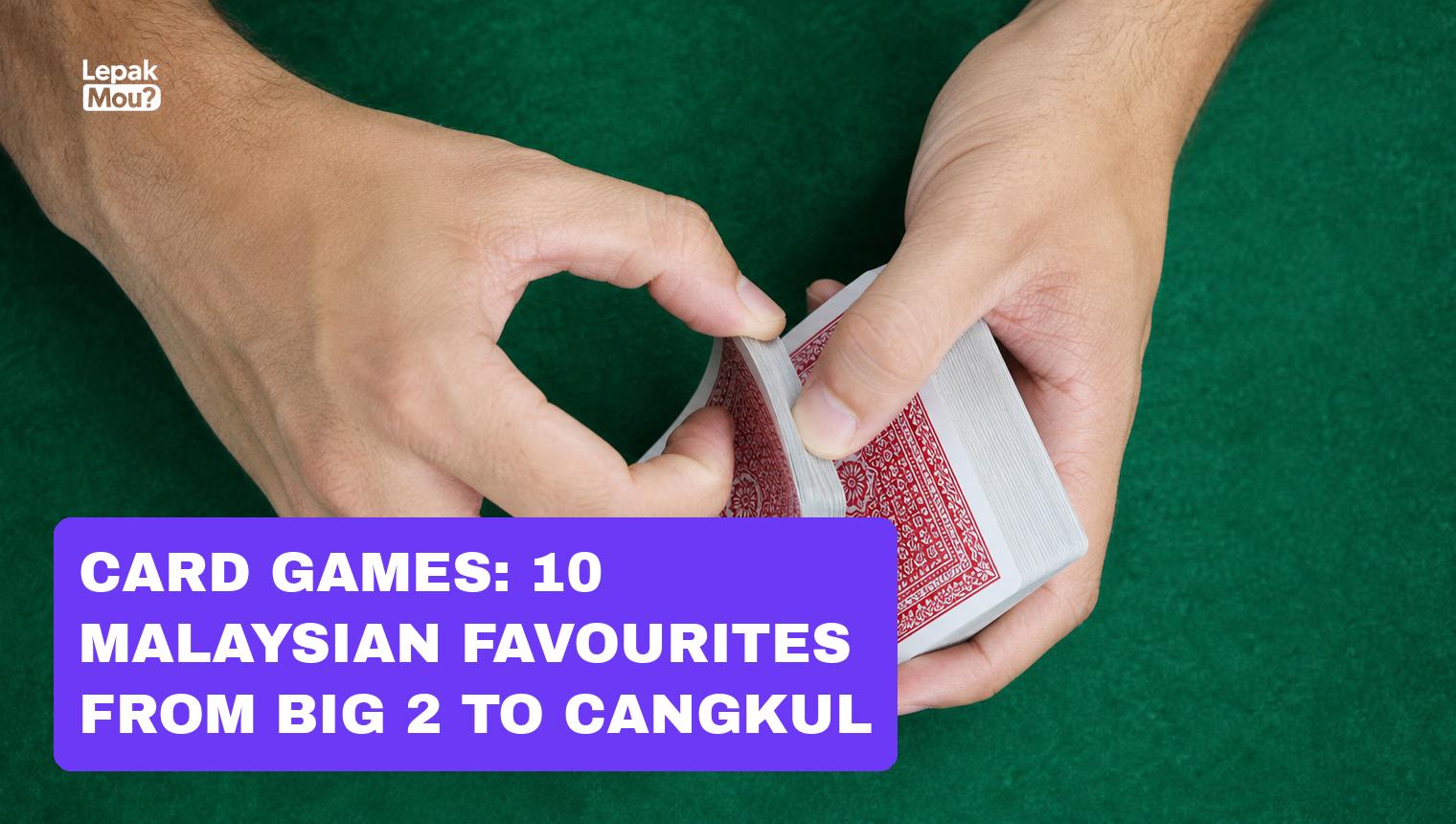
Card games are what Malaysians reach for when the makan is done and nobody wants to go home yet. At a CNY open house, someone clears the coffee table and a cousin produces a slightly bent deck.
Soon the whole living room is shouting about whether a flush beats a straight.
Mobile games are fun, but nothing beats real cards on the table once the gang gets competitive.
This guide covers the card games to play with friends and family that Malaysians actually grew up with, not the ones that only show up in Western listicles. You get 10 games with how-to-play basics, a quick comparison table, the best picks for two players, and a running order for a proper Chinese New Year card night.
Every set of rules is written so a first-timer can sit down and play tonight.
Best Card Games at a Glance: Quick Comparison
Six of these games need only a standard 52-card deck. Uno, Exploding Kittens, Monopoly Deal and Happy Family each need their own branded or illustrated deck.
| Game | Players | Deck Needed | Difficulty | Best For | Avg Round Time |
|---|---|---|---|---|---|
| Big 2 | 4 (best) | Standard 52 | Medium | CNY, friends | 10-15 min |
| Ban Luck | 3-8 | Standard 52 | Easy | CNY, big groups | 2-3 min |
| Chinese Poker | 2-4 | Standard 52 | Hard | Adults, poker fans | 5 min |
| Cangkul | 3-5 | Standard 52 | Easy | Small groups | 10 min |
| Donkey | 3-8 | Standard 52 | Easy | Big groups, teasing | 10-15 min |
| Old Maid | 3-6 | Standard 52 | Very easy | Young kids | 5-10 min |
| Happy Family | 3-6 | Illustrated deck | Very easy | Kids 5+ | 15 min |
| Uno | 2-10 | Uno deck | Easy | Mixed ages | 15-20 min |
| Exploding Kittens | 2-5 | Branded deck | Easy | Adults, young adults | 15 min |
| Monopoly Deal | 2-5 | Branded deck | Medium | Two players, families | 15 min |
Types of Card Games You Should Know
Most card games fall into a handful of families. Once you know which family a game belongs to, picking up the rules gets much easier.
- Shedding games: The goal is to get rid of all your cards first. Big 2, Cangkul, Donkey and Uno all work this way, so the tension builds as hands get smaller.
- Comparing or banking games: You try to beat the banker or the other players’ hands. Ban Luck is a classic banker game, while Chinese Poker has everyone comparing arranged hands at the same time.
- Matching or collecting games: You form pairs or complete sets. Old Maid is about pairing up, and Happy Family is about collecting full families of four.
- Modern boxed party games: These use custom decks with action cards and special rules printed right on them. Exploding Kittens and Monopoly Deal are good examples.
There are also trick-taking games like Bridge, which have a loyal following, but they take longer to learn and are not covered here.
10 Card Games to Play With Friends and Family
These picks actually get played at Malaysian tables and can be taught in about five minutes. Between them, they cover every group size from two people to a full house of cousins.
1. Big 2 (Traditional)
Big 2 goes by many names. Cantonese speakers call it Choh Dai Di (锄大地), often shortened to Dai Di, and it is huge in Malaysia, Singapore and Hong Kong.
It is a shedding game with a bit of poker mixed in, and it is the one game on this list that can turn a quiet uncle into a trash-talker.
Big 2 rules, step by step:
- Four players each get 13 cards.
- Whoever holds the 3 of diamonds leads first. Many tables require that card to be part of the opening play.
- Card ranking runs from 3 (lowest) up to K, then A, then 2 (highest). That is why it is called Big 2.
- Suit order in most Malaysian homes is diamonds < clubs < hearts < spades. Some families rank the suits differently, so settle this before dealing.
- You can play singles, pairs, triples or five-card hands.
- The next player must beat the last play using the same number of cards, or pass.
- When everyone else passes, the last player to play leads fresh with any combination.
- The first player to empty their hand wins the round.
Five-card hands follow this order, from weakest to strongest:
| Rank | Five-Card Hand | Example |
|---|---|---|
| 1 (lowest) | Straight | 4-5-6-7-8 of mixed suits |
| 2 | Flush | Any five hearts |
| 3 | Full house | Three 9s plus two Js |
| 4 | Four of a kind plus one card | Four Qs plus any single card |
| 5 (highest) | Straight flush | 5-6-7-8-9 of spades |
These five hands keep the same order as in the poker hand rankings, so learning one helps with the other.
Scoring: One common method charges losers a penalty point for each card left in hand, with the penalty doubled if you are stuck with 10 or more cards. Some tables triple it if you never played a single card.
House rules vary a lot here, so agree on scoring before the first deal.
Local tip: hold back your 2s. Players who throw them early to win a small trick usually regret it when they need control later in the round.
2. Ban Luck (Traditional)
Ban Luck is the Malaysian and Singaporean cousin of Blackjack, and it is basically the unofficial game of CNY. One player acts as banker, and everyone else tries to get closer to 21 than the banker without going over.
- Everyone, including the banker, gets two cards.
- Ban Ban (two aces) is usually the best hand, with Ban Luck (an ace plus a 10 or picture card) next.
- If you do not have a special hand, draw more cards one at a time to get closer to 21.
- The common house rule says you need at least 16 before you are allowed to stand.
- Five cards that total 21 or under usually earn a bonus.
- Rotate the banker every few rounds so nobody gets stuck in the hot seat.
Ace values are where every family argues. An Ace counts as 1, 10 or 11, whichever helps your hand most, according to GameRules.
Some families limit the Ace to 1 once you hold three or more cards, so check before you play.
How it differs from Blackjack: In casino Blackjack the Ace is only 1 or 11, and a house dealer plays by fixed rules. In Ban Luck the banker rotates among friends, and special hands like Ban Ban and five-card hands score extra.
Ban Luck is commonly played for money, so read the responsible play section below. Kuaci, sweets or a simple points tally keep the fun without the stress.
3. Chinese Poker (Traditional)
Chinese Poker gives each player 13 cards, which you arrange into three hands: a back hand (5 cards), a middle hand (5 cards) and a front hand (3 cards). The back must be at least as strong as the middle, and the middle at least as strong as the front.
If you get the order wrong, your hand “fouls” and you lose automatically.
Once everyone reveals, hands are compared row by row against each opponent. Win a row and you score 1 point.
Win all three rows and you get a bonus for the “scoop”. It uses the standard poker hand rankings, so it is a natural bridge for poker fans who want something slower and more strategic.
Most of the game happens in your head while arranging, and that is where the real skill lies.
4. Cangkul (Traditional)
Cangkul means “hoe” in Malay and Indonesian, and the name comes from the way you “dig” into the draw pile when you cannot follow suit. The game comes from Indonesia, according to card game site Pagat.
- Deal 7 cards each, though some tables use 5.
- Place the rest face down as the stock pile.
- The lead player plays any card, and everyone must follow that suit.
- If you cannot follow suit, you draw from the stock until you get a playable card.
- The highest card of the led suit wins the round, and that player leads next.
- The first player to empty their hand wins.
Tables differ on what happens when the stock runs out, so agree on it early. Cangkul works best with 3 to 5 players.
5. Donkey (Traditional)
First, this Donkey card game is not the Western game where people grab spoons. It is a shedding game also known as Bhabhi or Thulla, and “donkey” translates kalutai, the Tamil name for the loser, as card game site Thulaa explains.
- Deal out the whole deck.
- The holder of the ace of spades usually starts.
- Everyone must follow the suit led. If everybody follows, the cards are discarded and the highest card leads next.
- If someone cannot follow, they throw any card instead. This is the “tok” or “chop”.
- The player who played the highest card of the led suit picks up the whole pile and leads next.
- Players race to empty their hands. The last one still holding cards is the Donkey.
The group teasing of the Donkey is half the fun, and some families make the loser shuffle and deal the next round.
6. Old Maid (Traditional)
The Old Maid card game is the easiest on this list. Remove one queen from a standard deck, deal everything out, and let players discard any pairs.
Then take turns drawing a card from your neighbour’s hand, pairing up whenever you can. Whoever gets stuck with the unpaired queen loses.
Some families remove a joker or another card instead. It is perfect for young kids during the school holidays and family gatherings.
7. Happy Family (1851)
Known as Happy Families in the UK, this game’s original illustrated deck is widely credited to John Jaques & Son around 1851. Players ask a specific person for a specific family member, like Mr Bun the Baker’s son, and keep asking as long as they guess right.
Complete the most families of four to win. It needs an illustrated deck, and many Malaysians remember it from childhood.
It is great for kids aged 5 and up and quietly builds memory skills.
8. Uno (1971)
Created in 1971 and now owned by Mattel, Uno has players match the top card by colour or number. Action cards like Skip, Reverse, Draw Two and Wild Draw Four keep it chaotic, and forget to shout “Uno” on your last card and you have to draw.
It is the universal crowd-pleaser that works across generations and language groups, and it is widely sold in Malaysian bookshops and toy stores.
9. Exploding Kittens (2015)
Exploding Kittens launched in 2015 after a record-breaking Kickstarter campaign. Players take turns drawing until someone pulls an Exploding Kitten without a Defuse card and is out.
It is the best pick here for adult and young-adult friend groups, and the base box handles 2 to 5 players, so it doubles as a solid two-player option.
10. Monopoly Deal (2008)
Released in 2008 by Hasbro, Monopoly Deal plays in about 15 minutes. The first player to collect three full property sets wins, and action cards like Deal Breaker and Sly Deal let you steal from others.
It works for 2 to 5 players and makes a nice gift for families. Think of it as Monopoly without the three-hour family fight.
Best Card Games for Two Players
Most card games shine with a crowd, but a few work just as well for couples on a night in or housemates killing time after work.
- Monopoly Deal: Arguably the best of the lot for two. Plenty of back-and-forth stealing, no dead turns.
- Exploding Kittens: Fast and tense, with each draw feeling risky.
- Uno: Playable, but weaker at two since Reverse basically becomes a Skip.
If you want more 2 player card games, Gin Rummy and Speed (also called Spit) are classic extras worth learning with a standard deck.
Planning a night out instead? See our date ideas in KL.
Chinese New Year Card Games: Hosting a Proper Card Night
The best Chinese New Year card games night has a natural flow as the evening goes on. Here is a running order that keeps every age group busy:
| Time of Night | Who’s Playing | Game |
|---|---|---|
| Early evening | Kids | Old Maid or Happy Family |
| After dinner | Teen and adult cousins | Big 2 and Donkey |
| Late night | Adults | Ban Luck or Chinese Poker |
A few practical tips. Bring 2 or 3 decks because cards always go missing, usually under the sofa.
Use kuaci, sweets or poker chips instead of cash. Most importantly, agree on house rules before the first deal.
The classic CNY argument is whether a full house beats a flush in your family, and sorting that out early saves a lot of drama later.
Mahjong table full? Our guide on how to play mahjong will get you ready to join the aunties.
Need a break from cards? Our carrom rules guide covers the other family-gathering classic.
Card Game Etiquette and House Rules
Every family has its own rules, and that is part of the charm. A few basics keep everyone happy:
- Agree on variants before dealing. The Big 2 suit order debate alone has ruined many a reunion night.
- Rotate the dealer or banker fairly.
- No peeking, and no slow-rolling a winning hand just to watch someone squirm.
- The loser shuffles. This rule is non-negotiable.
- Win gracefully. Gloating is allowed for exactly one minute.
Play Responsibly: Keep the Stakes Friendly
Games like Ban Luck and Chinese Poker are commonly played for money, so it is worth being clear about this. Gambling is regulated in Malaysia, and gaming outside licensed operators falls under the Common Gaming Houses Act 1953, which you can look up through the Attorney General’s Chambers of Malaysia.
Muslims are also prohibited from gambling. This article is not legal advice, so check the rules that apply to you.
The easy fix is to play for snacks, chores or points. Loser washes the dishes, winner picks the supper spot.
Keep kids out of any game played for stakes, even small ones.
If gambling has someone chasing losses, hiding how much they play or stressed about money, reach out to a doctor or a recognised counselling service. Organisations like Befrienders Kuala Lumpur offer confidential emotional support.
Card Games Online and on Mobile
If your friends are scattered across states, classic card games like Solitaire, Hearts and Spades can be played for free in a browser on sites such as CardGames.io. Big 2 has plenty of fan-made versions on mobile app stores, and the official UNO! mobile app from Mattel has been widely available on Android and iOS.
Check that any app you download is free-to-play and steer clear of anything involving real-money betting.
For something different, Balatro turns poker hands into a roguelike, and it shows up on many lists of the best indie games. If you want full-on video games instead, browse the top games of 2026.
Still, nothing beats a physical deck at a real table.
Want a bigger table and someone to teach the rules? Try one of the board game cafes in KL.