
How to Play Poker: Texas Hold’em Rules & Beginner Guide
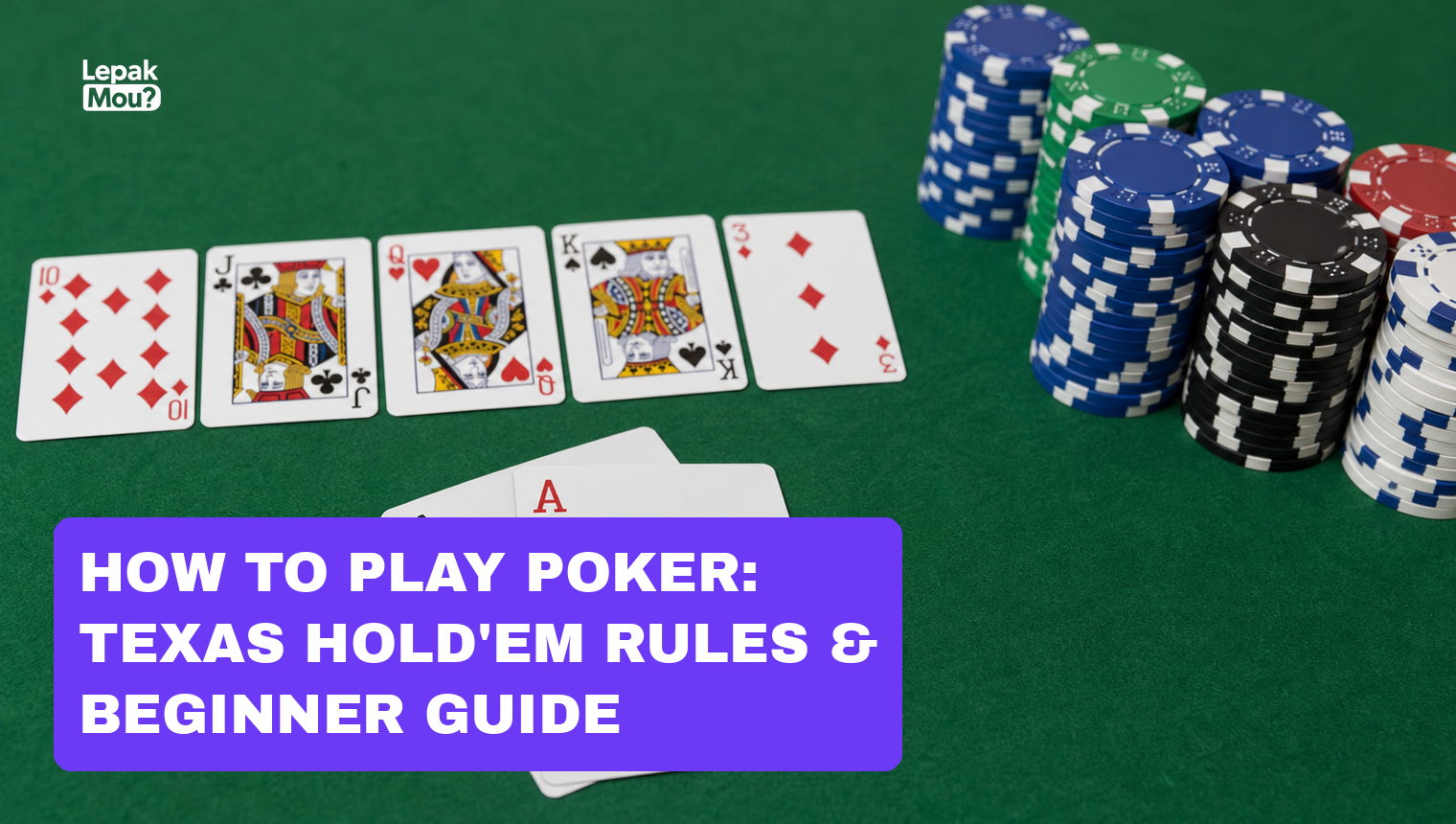
Picture this. It’s late at a family gathering, the kids are asleep, and your cousin pulls out a deck of cards and a box of chips.
Everyone sits down except you, because you’re the only one who never learned how to play poker. This guide fixes that.
These days, “poker” almost always means Texas Hold’em, the version you see on TV and at most home games. Give this guide about 10 minutes and you’ll understand a full hand from start to finish.
You’ll also learn the rules that trip up beginners and how to run a chill poker night with your kaki.
Everything is explained in chips and points only, no real money involved.
Quick Start: Poker in 5 Lines
- Every player gets 2 private cards (hole cards).
- 5 shared community cards are dealt face up in the middle.
- There are 4 betting rounds: pre-flop, flop, turn and river.
- The best 5-card hand at the end wins the pot.
- Or you win by betting until everyone else folds.
What Is Texas Hold’em Poker?
Poker isn’t really one game. It’s a family of card games that share the same hand rankings and the idea of betting on who holds the best hand.
Texas Hold’em, sometimes just called Texas poker, is by far the most played version worldwide, so that’s what this guide teaches.
The core idea is simple. Each player combines their 2 private hole cards with 5 shared community cards, then uses the best 5 of those 7 cards to make a hand.
There are two ways to win a pot (the pile of chips everyone has bet):
- Showdown: you have the best hand when the cards are revealed at the end.
- Everyone folds: you bet, and nobody wants to match you, so the pot is yours without showing a single card.
Other variants exist, like Omaha (4 hole cards) and Five-Card Draw (no community cards). Once you know Texas hold em, picking those up is much easier because the hand rankings stay the same.
What You Need to Play: Deck, Chips & Players
The setup is very basic. You need:
- A standard 52-card deck: Remove the jokers. Hold’em doesn’t use them.
- A set of chips: These are just a way to keep score. No chips? Use sweets, matchsticks or a scoring app.
- A dealer button: Any coin, bottle cap or Milo tin lid works. It marks who is “dealer” for that hand.
- 2 to 10 players: 6 to 9 is the sweet spot for a lively game.
For a simple home chip set, try this: white = 1, red = 5, green = 25. Give each player 100 units to start, for example 10 whites, 8 reds and 2 greens.
Need a set? Our poker chips guide covers chip types, set sizes and current prices in Malaysia.
Poker Hand Rankings: The 60-Second Version
You can’t play without knowing what beats what. Here are the 10 hands from strongest to weakest:
| Rank | Hand | Example | What it means |
|---|---|---|---|
| 1 | Royal Flush | A♠ K♠ Q♠ J♠ 10♠ | A-K-Q-J-10, all the same suit |
| 2 | Straight Flush | 9♥ 8♥ 7♥ 6♥ 5♥ | Five in a row, same suit |
| 3 | Four of a Kind | Q Q Q Q 4 | Four cards of the same rank |
| 4 | Full House | K K K 7 7 | Three of a kind plus a pair |
| 5 | Flush | A♦ J♦ 8♦ 5♦ 2♦ | Any five cards of the same suit |
| 6 | Straight | 10 9 8 7 6 | Five in a row, mixed suits |
| 7 | Three of a Kind | 8 8 8 K 3 | Three cards of the same rank |
| 8 | Two Pair | J J 5 5 A | Two different pairs |
| 9 | One Pair | 10 10 K 6 2 | Two cards of the same rank |
| 10 | High Card | A Q 9 6 3 | Nothing connects, highest card plays |
Beginner trap: a flush beats a straight. Many new players get this backwards.
Also, suits never rank against each other in Hold’em. A spade flush is not “better” than a heart flush.
You compare the highest cards instead.
For tricky what-beats-what spots and how rare each hand is, see our full poker hand rankings chart.
Texas Hold’em Rules: Dealer Button, Blinds & Positions
Before any cards come out, Texas Holdem rules need someone to put chips in the middle, otherwise there’s nothing to play for. That’s where the button and blinds come in.
The dealer button marks the player who acts last after the flop. It moves one seat clockwise after every hand, so everyone takes turns at every position.
In home games, the person with the button often deals the cards too.
The blinds are forced bets:
- Small blind (SB): the player directly left of the button posts a small amount.
- Big blind (BB): the next player to the left posts double that.
Example: in a game with 1/2 blinds, the small blind puts in 1 chip and the big blind puts in 2 chips before the cards are dealt.
Here’s how seats are named at a 9-player table, going clockwise from the button:
| Position | Where it sits | Why it matters |
|---|---|---|
| Button (BTN) | Holds the dealer button | Acts last on the flop, turn and river. The best seat. |
| Small Blind (SB) | Left of the button | Posts half a big blind, acts first after the flop |
| Big Blind (BB) | Left of the small blind | Posts the full blind, acts last pre-flop |
| Under the Gun (UTG) | Left of the big blind | Acts first pre-flop, so needs stronger hands |
| Middle positions | The seats after UTG | A bit more information before acting |
| Cutoff (CO) | Right of the button | Second-best seat after the button |
The key action-order rule: pre-flop, the player left of the big blind acts first. On the flop, turn and river, the first active player left of the button acts first.
Why does this matter? Acting last means you see what everyone else does before you decide.
If three people check to you, you know they’re probably weak. That information is a big edge, and it’s why the button is the seat everybody wants.
How to Play Texas Hold’em Step by Step
Every hand follows the same four betting rounds, then a showdown if more than one player is left. Here’s the overview before we break down how to play Texas Holdem step by step:
| Round | Cards dealt | Who acts first |
|---|---|---|
| Pre-flop | 2 hole cards to each player (face down) | Player left of the big blind |
| Flop | 3 community cards (face up) | First active player left of the button |
| Turn | 1 community card (face up) | First active player left of the button |
| River | 1 community card (face up) | First active player left of the button |
Before the flop, turn and river, the dealer “burns” (discards face down) the top card of the deck. This protects against anyone catching a glimpse of the next card.
Step 1: Pre-Flop. Deal the Hole Cards
After the blinds are posted, each player gets 2 face-down cards, dealt one at a time clockwise starting with the small blind. Look at yours without showing anyone.
Starting left of the big blind, each player chooses to fold (give up), call (match the big blind) or raise (bet more). If nobody raises, the big blind can simply check, which is called “the option”.
A hand like A-K is strong enough to raise. A hand like 7-2 offsuit (different suits) is the classic fold.
Once all bets are matched, the flop comes.
Step 2: The Flop. Three Community Cards
The dealer burns one card, then places 3 cards face up in the middle. These belong to everyone.
A new betting round starts with the first active player left of the button, and now you can check if no one has bet yet.
The flop can change everything. Say you hold 9♥-8♥ and the flop is 7♥-6♣-K♥.
You don’t have a made hand yet, but you have a flush draw (one more heart) and a straight draw (a 5 or a 10). When the betting is done, it’s on to the turn.
Step 3: The Turn. The Fourth Card
Burn one card, then deal one more community card face up. Another betting round follows, in the same order as the flop.
Bets often get bigger here because fewer unknowns are left.
Once the betting closes, the river is dealt.
Step 4: The River. The Final Card
The dealer burns one last card and deals the fifth and final community card. Then comes the last betting round.
No more cards are coming, so every hand is now fixed. This is where bluffs often happen, because a player who missed their draw has no other way to win except by betting and hoping you fold.
If two or more players are still in after the betting, it goes to showdown.
Step 5: The Showdown. Who Wins the Pot
Remaining players reveal their cards. The last player who bet or raised on the river shows first.
If everyone checked, showing starts with the first active player left of the button.
You make your best 5-card hand from any combination of your 2 hole cards and the 5 board cards. You can use both, one or even zero of your hole cards.
Using zero is called “playing the board”. The best hand takes the pot, then the button moves and a new hand starts.
Poker Betting Options: Check, Bet, Call, Raise & Fold
On your turn, you have up to five choices, depending on what happened before you:
| Action | What it means | When you can do it |
|---|---|---|
| Check | Pass the action without betting | Only if no one has bet in this round |
| Bet | Put the first chips in for this round | Only if no one has bet yet |
| Call | Match the current bet | When someone has bet before you |
| Raise | Increase the current bet | When someone has bet before you |
| Fold | Give up your cards and any chips already in | Any time it’s your turn |
Minimum raise rule: a raise must be at least the size of the previous bet or raise. If someone bets 10 chips, you must raise to at least 20 chips total.
All-in: you push every chip you have into the pot. You can’t be forced out of a hand for not having enough chips.
If you can’t match a bet, going all-in lets you stay in for the amount you have (more on side pots below).
Etiquette tip: say your action out loud (“raise to 20”) before touching your chips. Dropping chips in bit by bit, called a “string bet”, causes arguments at home games.
Announce first, then move chips.
No-Limit vs Pot-Limit vs Fixed-Limit Poker
The betting structure decides how much you’re allowed to bet. Agree on this before the first hand.
| Structure | Maximum bet | Best for |
|---|---|---|
| No-Limit | Any amount up to your whole stack | The most common format, exciting but swingy |
| Pot-Limit | Up to the current size of the pot | Common in Omaha, a middle ground |
| Fixed-Limit | Set bet sizes per round (e.g. 2 on pre-flop and flop, 4 on turn and river) | First-time players, fewer big mistakes |
All three use table stakes. You can only bet the chips in front of you at the start of the hand.
No reaching into your pocket mid-hand for more.
For a first home game, I’d go with fixed-limit, or no-limit with small stacks like the 100 units above. Nobody loses all their chips on hand three and ends up sitting around scrolling their phone.
Sample Hand: A Full Round of Texas Hold’em, Played Out
Let’s put it all together. Four friends at a Friday game night, 1/2 blinds, 100 chips each.
Wei Jie has the button, Mei Ling is small blind, Raj is big blind and Josh is under the gun.
| Stage | What happens | Pot |
|---|---|---|
| Blinds | Mei Ling posts 1. Raj posts 2. | 3 |
| Pre-flop | Josh holds 7♣-2♦ and folds. Wei Jie holds K♠-K♦ and raises to 6. Mei Ling holds Q♥-J♥ and calls (adds 5). Raj holds 9♣-4♠ and folds. | 14 |
| Flop: 8♥-4♥-2♣ | Mei Ling now has a flush draw. She acts first and checks. Wei Jie bets 8. Mei Ling calls. | 30 |
| Turn: 3♠ | No heart for Mei Ling. She checks. Wei Jie bets 15. Mei Ling calls, still chasing. | 60 |
| River: 10♣ | Mei Ling misses her flush. Her only way to win is a bluff, so she bets 25. Wei Jie thinks it over and calls. | 110 |
| Showdown | Mei Ling bet last, so she shows first: queen high. Wei Jie shows a pair of kings and wins the 110-chip pot. | 110 to Wei Jie |
What we learned: Wei Jie’s strong starting hand held up because Mei Ling kept paying to chase a draw that never came. Josh and Raj lost little by folding weak hands early, which is exactly the habit beginners should copy.
Poker Game Rules Beginners Often Get Wrong
Most home-game arguments come from a few poker game rules that nobody explained properly. Here they are:
- Kickers break ties: If you both pair the ace, the next-highest card (the kicker) decides it. On a board of A-J-8-5-3, A-K beats A-Q because K outranks Q.
- Identical hands split the pot: If both players have the exact same best 5 cards, for example both playing the board, the pot is shared equally.
- Side pots for short all-ins: Say Player A goes all-in for 20, and B and C each put in 50. The main pot is 60 (20 from each), and all three can win it. The side pot is 60 (the extra 30 from B and C), and only B or C can win that.
- You don’t have to show to win: If everyone else folds, you take the pot and can keep your cards hidden. Showing is only required at showdown.
- Exposed cards get replaced: If the dealer accidentally flips a player’s hole card, that card is usually replaced. If a community card comes out early, it’s typically reshuffled into the deck and the board is re-dealt.
Poker for Beginners: 7 Tips to Stop Losing Chips
Knowing the rules is step one. These poker for beginners tips will stop you from bleeding chips in your first few games:
- Play fewer hands: Fold most hands pre-flop. Hands like 7-2 or 9-3 offsuit are not worth a call, no matter how bored you feel.
- Use your position: Play more hands on the button and cutoff, and fewer from under the gun, where everyone acts after you.
- Don’t chase every draw: Most draws miss, just like Mei Ling’s flush above. Paying big bets to chase them is how beginners lose their stack.
- Bluff less than you think: Beginners at home games love to call. If your friends call almost everything, stop bluffing and just bet your strong hands.
- Watch how others bet: If Raj only ever raises with big pairs, his raise tells you a lot. Pay attention even when you’ve folded.
- Set a chip limit and stick to it: Decide before the night starts, for example one rebuy only. It keeps the game friendly.
- Don’t tilt after a bad beat: “Tilt” means playing angry after losing a big hand. Sit out a round, get another teh tarik, then come back.
How to Host a Poker Night with Friends
Honestly, this is where poker is the most fun. Not in a casino, but around a dining table with snacks and too much trash talk.
The setup: a table that fits everyone, one or two decks (swapping between them speeds up dealing), a chip set, a coin for the button, and plenty of food. Kuaci, keropok and a big tapau order from the nearest mamak works well.
Plan for 2 to 3 hours. Any longer and people start fading.
Agree on house rules before the first hand:
- Blind levels and when they go up (e.g. 1/2 for the first hour, then 2/4)
- Whether rebuys are allowed and how many
- Chips or points only. The winner gets bragging rights, maybe the last piece of kuih.
Traditional poker has a “kitty”, a shared fund for refreshments. At a home game, keep it simple: everyone chips in for food upfront, completely separate from the game.
Nobody takes a cut of any pot.
Not everyone in your group will want four hours of cards. Rotate in other games, or switch to a console for a round of couch-friendly indie games once the poker winds down.
Other good rotations are Big 2 and Ban Luck from our card games guide, a few rounds of mahjong or a carrom board. Rather let someone else handle the setup?
Try a board game cafe in KL.
Is Poker Legal in Malaysia? Play Responsibly
Gambling in Malaysia is tightly regulated under laws including the Common Gaming Houses Act 1953 and the Betting Act 1953. You can look both up through the Attorney General’s Chambers of Malaysia.
For adults visiting Genting Highlands, Resorts World Genting’s casino page says visitors must be over 21, and Malaysian citizens must be non-Muslim.
Genting has plenty more to do besides, like the Genting SkyWorlds theme park.
Online is a different story. In 2023, the Court of Appeal ruled that online gambling is an offence under the Common Gaming Houses Act 1953.
My advice: learn the game and play for chips, points or bragging rights only. That’s the safest way to enjoy it, and it’s how the game works best among friends anyway.
Please note: this section is general information, not legal advice. Laws can change, so check current regulations or speak to a lawyer if you’re unsure.
If gambling ever stops being fun, for you or someone close to you, talk to someone. Befrienders KL offers free, confidential emotional support, and a counsellor can help you take the next step.
Ready to Deal?
That’s everything you need to sit down at the table with confidence. Grab a deck, gather your kaki, and deal the first hand lah.