Slot Machine Explained: How It Works, Odds & Jackpots
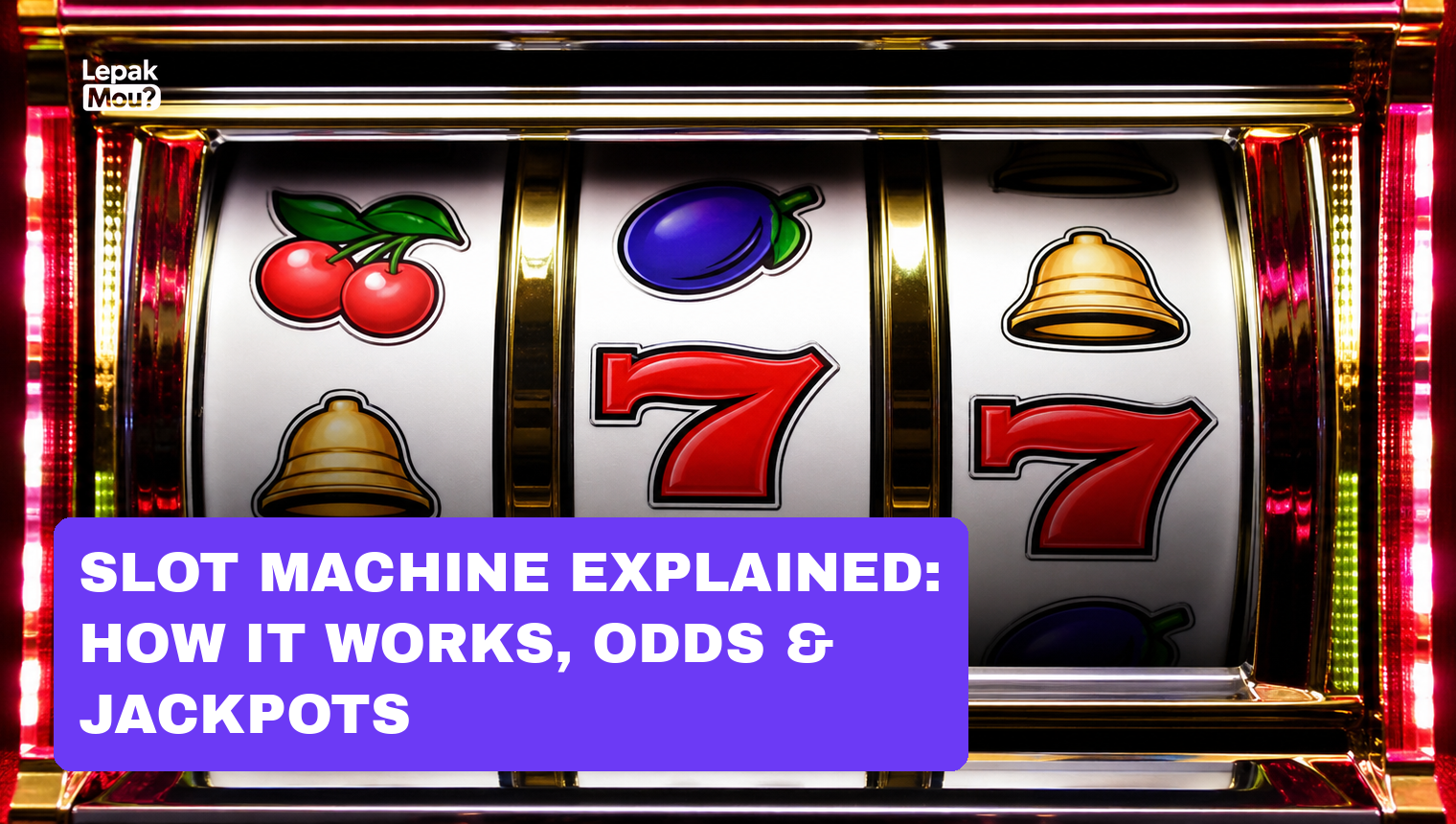
Picture the casino floor at Genting: rows of flashing lights, cheerful jingles and reels spinning like they have a mind of their own. What most people never realise about a slot machine is that a computer chip decides each spin before the reels even stop.
This guide explains how slot machines work, how their odds and jackpots are worked out, where slots stand under Malaysian law and how to play responsibly. Every example uses game credits or units, not real money.
Note: This is an educational guide, not a recommendation to gamble. In Malaysia, casino gambling is only legal at Resorts World Genting, for visitors above 21, and Malaysian citizens must be non-Muslim.
What Is a Slot Machine?
A slot machine is a gambling machine where you stake credits on each spin and win according to the symbols that land on the paylines. It pays out from a fixed pay table, and the casino’s profit is built into the maths of every game.
Encyclopaedia Britannica credits Charles Fey, a mechanic in San Francisco, with building the first coin-operated gambling machine in 1894. His Liberty Bell followed in 1899, with three reels and a lever on the side.
That lever gave slots the nickname “one-armed bandit”. According to Wikipedia’s slot machine entry, the name refers to the big side levers and the way the games drain players’ pockets.
Bally built the first fully electromechanical slot, Money Honey, in 1963. The first video slot followed in 1976, made by Fortune Coin Co., and screens slowly replaced physical reels.
Today almost every slot is essentially a computer running a game program. Many Malaysians simply call them “jackpot” machines, but the idea is the same: you pay to play, and software decides the result.
How Do Slot Machines Work?
The modern flow is simple once you strip away the lights and sound. When you press spin, this is what happens:
- The machine deducts your stake in credits.
- It takes the latest number from its random number generator (RNG).
- It maps that number to a stopping position for each reel.
- Only then does it animate the reels, which stop on a result that was already fixed.
So the spinning animation is pure theatre. Some machines have a stop button, and it feels like you are taking control, but the outcome was locked in when you pressed spin.
The New York State guide to how gambling machines work makes the same point. It says outcomes are determined by an RNG and are not influenced by previous results.
The Slot Machine RNG
The RNG is software that keeps generating numbers non-stop, even when nobody is sitting at the machine. Think of a lucky-draw box that never stops shuffling, where your button press grabs whatever ticket happens to be on top.
Because of this, each spin is independent. The machine has no memory, so it does not know you have lost ten times in a row or that someone else just won.
In regulated markets, independent labs such as Gaming Laboratories International (GLI) test and certify electronic gaming machines. Testing checks that a game behaves as approved, but it does not change the fact that the odds favour the house.
Virtual Reels and Weighted Symbols
The reels you see are only part of the picture. Behind the scenes, the software maps each RNG number to a much bigger “virtual reel”, where some symbols take up far more positions than others.
Wikipedia gives the example of virtual reels with 256 stops each, which across three reels allows 16,777,216 possible outcomes. Common symbols and blanks get lots of positions, while the jackpot symbol gets very few.
In this simplified example, the jackpot symbol takes 1 of 64 virtual stops on each of three reels. The chance of lining up three is 1 in 262,144 (64 × 64 × 64), and this is illustrative only, not any real machine’s setting.
Weighting also explains why near-misses feel so common. Two jackpot symbols with the third just off the line looks close, but the real chance of that third symbol landing is far lower than it appears.
Slot Paylines and Ways to Win
A payline is “a line that crosses through one symbol on each reel”, as Wikipedia puts it. On classic three-reel machines, there is usually just one, across the centre.
Modern video slots often have 20, 25 or 50 paylines zigzagging across five reels, and some let you choose how many to play. “Ways to win” formats, such as 243 ways, pay for matching symbols on adjacent reels from left to right, on any row.
More lines sounds like more chances, but it also costs more per spin. On a 25-line game at 1 credit per line, each spin costs 25 credits, so 100 spins puts 2,500 credits through the machine.
You can also win on one line while losing on the rest. If a 25-credit spin pays 10 credits on one line, you are still 15 credits down, even though the screen says you won.
Slot Machine Symbols
Slot machine symbols fall into a few families. Once you know them, a pay table becomes much easier to read.
The classic symbols are cherries, lemons and other fruit, BARs, bells and lucky 7s. Wikipedia traces the fruit to early machines that paid out in fruit-flavoured chewing gum, and the BAR symbol to the Bell-Fruit Gum logo.
Modern video slots add special symbols on top:
- Wilds: substitute for most other symbols to complete a winning line.
- Scatters: pay wherever they land, usually when three or more appear, and often trigger free spins.
- Bonus symbols: launch a feature round, like a pick-a-prize game or a wheel.
- Multipliers: multiply a win by a set amount, such as 2x or 5x.
Asian-themed games lean heavily on dragons, koi, gold ingots, lanterns and red packets. Very festive, but a dragon is just a graphic, and its value depends entirely on the pay table.
On older machines, the pay table sits on the face of the machine above or below the reels, and on video slots it is usually in a help menu. It works a bit like a poker hand rankings chart, showing exactly what each combination is worth.
Slot Machine Odds, RTP and House Edge
Slot machine odds come down to one number: return to player, or RTP. It is the long-run percentage of all stakes that a machine pays back to players as prizes.
The house edge is whatever is left. Wikipedia’s return to player entry gives the example of a 90% RTP game, which returns 90 of every 100 units wagered and keeps 10.
Machines can be programmed to pay back anywhere from 0% to 99%, so regulators often set a floor. Wikipedia lists legal minimums of 75% in Nevada, 80% in Mississippi and 83% in New Jersey.
Slots usually carry a bigger house edge than table games. The banker bet in baccarat has a house edge of 1.06% in an eight-deck game, according to Wizard of Odds.
Texas Hold’em works differently, because you play against other players rather than the house. The casino earns its cut through a fee taken from each pot, called the rake.
Here is what different RTPs mean in game units. The hourly column assumes an illustrative pace of 1 unit a spin and 500 spins an hour, so 500 units wagered per hour.
| RTP | House edge | Expected loss per 100 units wagered | Expected loss per hour (1 unit a spin, 500 spins) |
|---|---|---|---|
| 85% | 15% | 15 units | 75 units |
| 90% | 10% | 10 units | 50 units |
| 94% | 6% | 6 units | 30 units |
| 97% | 3% | 3 units | 15 units |
So at 1 unit a spin and 500 spins an hour on a 94% RTP game, you should expect to lose about 30 units an hour on average. Wins usually get fed back in, so a small starting balance can turn over many times its size in an hour.
Hit frequency is how often a spin returns anything at all. Volatility describes the pattern of wins: low-volatility games pay small amounts often, while high-volatility games pay rarely but bigger.
Most important of all, RTP says nothing about a single session. The UK Gambling Commission describes RTP as an average achieved over a significant number of games, not each time the machine is played.
Over the very long run, though, the maths always lands in the house’s favour. Our guide to what RTP means goes deeper into the calculation and volatility.
What Is a Slot Machine Payout?
A payout is the amount a winning combination returns, listed in the pay table as a multiple of the line bet or the total bet. If three BARs pay 50x and your line bet is 1 credit, that win returns 50 credits.
Don’t confuse “payout” with “payout percentage”. A payout is a single win, while payout percentage is another name for RTP, the long-run average across a huge number of spins.
A payout smaller than what the spin cost is still a loss. Pay 25 credits, win 10, and you are 15 credits down, however loudly the machine celebrates.
Progressive Jackpot Slots
A progressive jackpot grows over time. A small slice of every bet feeds the prize pool until someone wins, then it resets to a starting “seed” amount.
There are three main types:
- Standalone progressives: the jackpot is tied to a single machine.
- Linked progressives: a bank of machines in one casino shares a jackpot.
- Wide-area progressives: machines across many casinos feed one pool, which is how prizes get enormous.
The record belongs to a Megabucks machine. Guinness World Records lists a US$39,713,982.25 win at the Excalibur in Las Vegas on 21 March 2003, by a 25-year-old software engineer from Los Angeles.
Headlines like that come with trade-offs. Part of every stake goes to the jackpot pool, so less is left for regular wins, and the top prize is an extremely long shot.
Many progressives also require the maximum bet to qualify for the top prize. That is the only situation where “bet max” makes sense, and it is about eligibility, not better odds.
Slot Machine Myths That Cost Players Money
Every one of these myths falls apart once you understand the RNG section above. Each spin is independent and decided the instant you press the button.
- “This machine is hot (or cold)”: a machine that just paid out is no more or less likely to pay again. Streaks happen by chance, and the brain loves finding patterns in them.
- “It’s due for a win”: the New York State guide says machines do not adjust to a string of winning or losing games. A long dry spell does not make the next spin more likely to pay.
- “Stopping the reels early changes the result”: the result is set when you press spin. Stopping early only ends the animation sooner.
- “A near-miss means I’m close”: near-misses come from weighted virtual reels and game design. Two jackpot symbols and a third just off the line is still a loss.
One more trap is losses disguised as wins: spins where lights flash and music plays, but the machine returned less than your stake. A University of Waterloo study found that most participants miscategorised these spins as wins.
Slot Machines in Malaysia: What the Law Says
Casino gambling in Malaysia is legal only at the casino at Resorts World Genting in Genting Highlands, Pahang. Resorts World Genting’s casino page says visitors must be above 21, and Malaysian citizens must be non-Muslim.
The same page lists slot machines among its gaming machines. Under Syariah law, Muslims are not permitted to gamble.
Online is a different story. In 2023, the Court of Appeal ruled that online gambling is an offence under the Common Gaming Houses Act 1953, and online slot sites are no exception.
This guide does not name or recommend any online casino. Be very wary of any site, app or “agent” claiming to be legal in Malaysia.
Social casino apps such as Slotomania use virtual coins that cannot be cashed out. Buying those coins with a card or e-wallet is still real spending, and it adds up quickly.
A Genting trip does not need to involve the casino at all. There is Genting SkyWorlds for theme park rides and the Genting Premium Outlet for shopping.
This section is general information, not legal advice. See our editorial policy for how we research these guides, and speak to a qualified lawyer about any specific situation.
How to Play Slots Responsibly
If you are eligible and choose to play, treat it as paid entertainment. Plan it with numbers, not feelings.
- Set a budget before you arrive: treat it as the cost of the outing, like a concert ticket, and leave extra cards at home.
- Estimate the cost upfront: using the table above, 500 one-unit spins on a 94% RTP game cost about 30 units on average.
- Set a time limit: slots are fast, so an hour disappears quickly.
- Never chase losses: trying to win back what you lost is how small losses become big ones.
- Never borrow to gamble: not from friends, credit cards or loans.
- Skip it after drinking or when stressed: both make it harder to stop.
Warning signs worth taking seriously include borrowing money to gamble, hiding spending from family, and gambling to escape problems. Our guide to financial red flags covers how money secrets can strain relationships too.
Resorts World Genting runs a Responsible Gaming programme with permanent and 7-day self-exclusion, plus a Set My Limit tool for electronic gaming machines. Its 24-hour Responsible Gaming Hotline is +603-6105 9557.
If gambling is affecting your life, Befrienders KL offers free, confidential emotional support. Its 24-hour line is +603-7627 2929.
The Bottom Line on Slot Machines
Slots are pure chance, driven by an RNG that decides every spin before the reels stop. The house edge is built into each spin through RTP, so over time the casino always comes out ahead.
Progressive jackpots are long-shot lotteries attached to a slot, exciting to watch but very unlikely to land. If you play, treat it as paid entertainment with a predictable average cost, not a way to make money.
For a game night with no money involved, try these Malaysian card game favourites or learn how to play mahjong.