
How to Play Baccarat: A Beginner’s Guide to the Rules
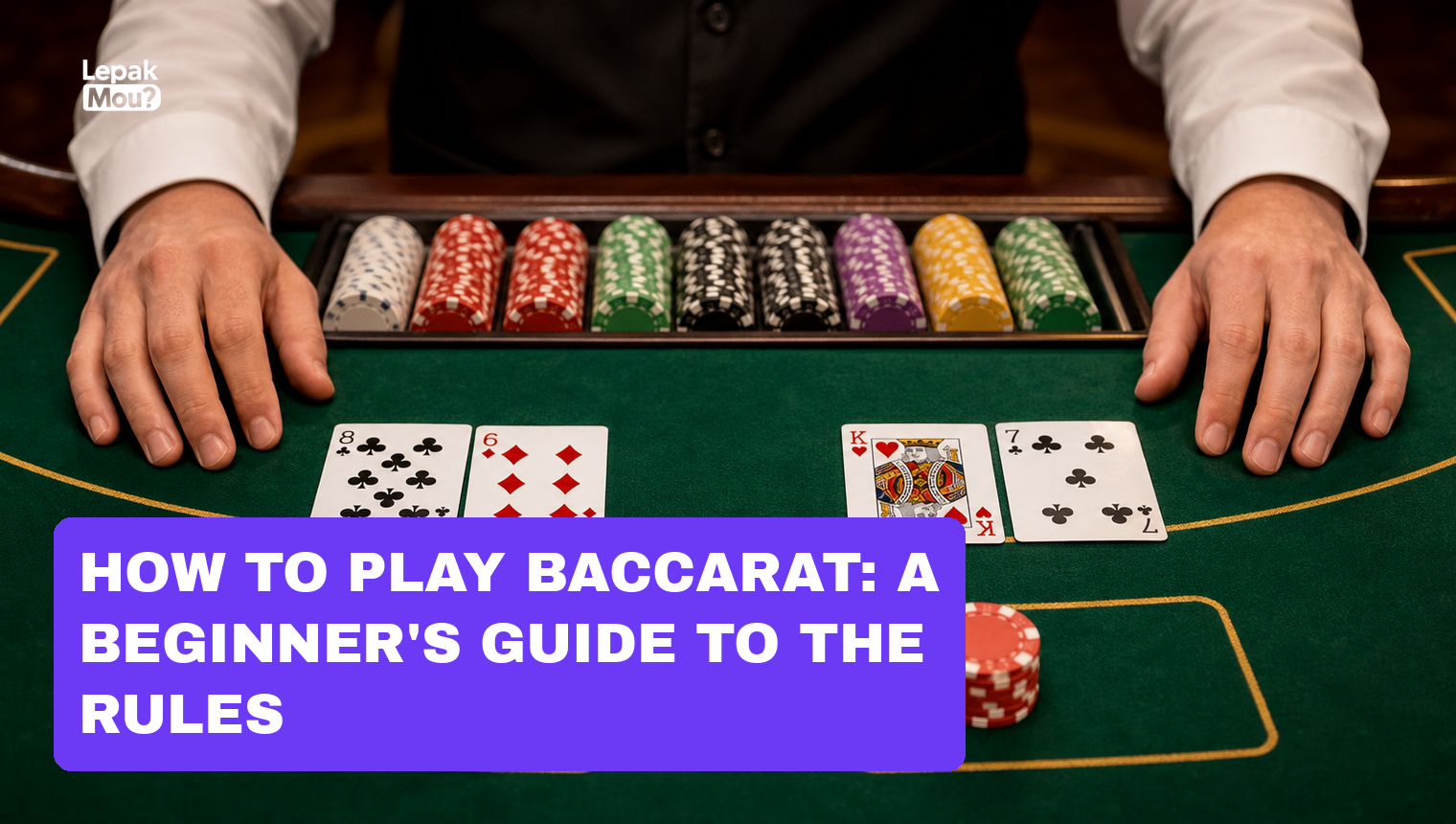
Baccarat looks intimidating. You see a big table, a dealer flipping cards fast and people at the high-limit area peeling their cards slowly like a drama scene.
But if you want to know how to play baccarat, the good news is that you only make one decision: bet on Player, Banker or Tie. Everything after that runs on fixed rules.
Quick answer: Bet on Player, Banker or Tie. Each hand gets two cards, the total closest to 9 wins, and a fixed rule decides whether a third card is drawn.
Mini baccarat is popular with casual players, particularly in Asia, according to Wikipedia. If you know Malaysian card games like Big 2 and Ban Luck, you’ll find the counting here even simpler.
This guide is purely educational. Gambling is heavily restricted in Malaysia, and nothing here encourages you to play.
What Is Baccarat? (Punto Banco Explained)
Baccarat is a card game where you bet on which of two hands, called Player and Banker, will finish closest to 9. That’s the whole objective.
The version you’ll find in most casinos is punto banco. “Punto” means Player and “banco” means Banker.
In punto banco, every drawing decision is fixed by the baccarat rules, so you never actually play a hand yourself. The cards are dealt on auto-pilot, a bit like a Grab driver following Waze without arguing.
One thing confuses many beginners. “Banker” and “Player” are just names for the two hands on the table.
Banker is not the casino and Player is not you. You can bet on either side.
Most tables deal from a “shoe” holding 6 or 8 standard decks shuffled together. On history, the game is generally traced to Italy or France, and that’s all you need to know.
Baccarat Card Values: How to Count a Hand
Counting in baccarat is simpler than it looks. Here are the baccarat card values:
| Card | Value |
|---|---|
| Ace | 1 |
| 2 to 9 | Face value (a 7 is worth 7) |
| 10, J, Q, K | 0 |
Then comes the “drop the tens” rule. If a hand adds up to 10 or more, only the last digit counts.
Some examples:
- 7 + 5 = 12, which counts as 2
- K + 9 = 9, since the King is 0
- 8 + 8 = 16, which counts as 6
The highest possible hand is 9, and you can never “bust” like in blackjack. There are no hand rankings to learn either, unlike the poker hand rankings.
A two-card total of 8 or 9 is called a natural. When either hand gets a natural, the round ends immediately and no more cards are drawn.
How to Play Baccarat Step by Step
Here’s how a round actually goes, from sitting down to getting paid:
- Buy chips and check the placard: Every table has a sign showing its minimum and maximum bets. Read it before you sit.
- Place your bet: Put your chips on Player, Banker or Tie. Some tables also offer side bets like Player Pair or Banker Pair.
- The deal: The dealer gives two cards each to Player and Banker, alternating between the two hands.
- Totals are announced: If either hand has a natural 8 or 9, the round stops here.
- The third card rule kicks in: If there’s no natural, fixed rules decide whether Player and Banker draw one more card.
- Closest to 9 wins: Winning bets are paid and losing bets are collected. Then the next round starts.
Notice that after step 2, you do nothing. No hit, no stand, no fold.
The dealer handles everything.
Worked example: You put 20 chips on Banker.
- Player gets 3 + 2 = 5. Under the rules, Player draws on 5 and gets a 6. That’s 11, which counts as 1.
- Banker gets 4 + 3 = 7. Banker always stands on 7.
- Banker wins, 7 against 1. Your 20 chips win 19 after the 5% commission, so you get 39 chips back in total.
Baccarat Banker and Player Bets Explained
These are the two main bets, and the payouts are slightly different:
- Player bet pays 1:1. Bet 20 chips, win 20.
- Banker bet pays 1:1 minus a 5% commission. Bet 20 chips, win 19.
Why the commission? Because Banker wins slightly more often.
Banker draws last, and its third card rule takes the Player’s third card into account. Over an 8-deck shoe, Banker wins roughly 45.9% of hands, Player about 44.6%, and ties land around 9.5%, according to the Wizard of Odds.
Even after the commission, Banker carries the lowest house edge in the game, about 1.06% against roughly 1.24% for Player. If the round ends in a tie, Player and Banker bets are a push in standard punto banco.
You don’t win, you don’t lose, you just get your stake back.
So who should you bet on in the baccarat banker and player choice? Honestly, Banker is mathematically a tiny bit better.
But neither bet beats the house over the long run. My tip is to treat that 0.18% gap as a fun fact, not a winning plan.
The Baccarat Tie Bet: Why Most Players Skip It
The baccarat tie bet usually pays 8:1, and some tables pay 9:1. Check the felt before you bet, because that number matters a lot.
Here’s the maths. Ties happen about 9.5% of the time.
At 8:1, that gives the house an edge of around 14.4%. At 9:1, it drops to about 4.8%.
Compare that with roughly 1% on Banker.
In plain terms: for every 100 units bet on Tie at 8:1, you’d expect to lose about 14.4 units on average. The same 100 units on Banker would lose about 1.06.
Side bets like Player Pair and Banker Pair also carry higher house edges than the two main bets. The bigger payouts look attractive on the table, but you pay for them in the long run.
Baccarat Third Card Rule
Good news first. You never need to memorise the baccarat third card rule to play, because the dealer applies it automatically.
This section is here so you understand why a third card suddenly appears. Treat it as a reference, not homework.
The order is always the same: check for naturals first, then apply the Player’s rule, then the Banker’s rule.
When Does the Player Draw a Third Card?
| Player’s two-card total | What happens |
|---|---|
| 0 to 5 | Player draws a third card |
| 6 or 7 | Player stands |
| 8 or 9 | Natural. No one draws. |
If the Player stands on 6 or 7, the Banker follows the same simple rule: draw on 0 to 5, stand on 6 or 7.
When Does the Banker Draw a Third Card?
This is where it gets slightly more detailed. If the Player has drawn a third card, the Banker’s move depends on its own total and the value of that Player’s third card:
| Banker’s total | Banker draws when Player’s third card is | Banker stands when Player’s third card is |
|---|---|---|
| 0, 1, 2 | Any card (always draws) | Never |
| 3 | Anything except 8 | 8 |
| 4 | 2, 3, 4, 5, 6, 7 | 0, 1, 8, 9 |
| 5 | 4, 5, 6, 7 | 0, 1, 2, 3, 8, 9 |
| 6 | 6, 7 | 0, 1, 2, 3, 4, 5, 8, 9 |
| 7 | Never | Any card (always stands) |
Worked example: Player starts with 2 and draws a 5 as its third card, making 7. Banker has 6.
Looking at the table, Banker on 6 only draws if the Player’s third card is 6 or 7. The third card was a 5, so Banker stands.
Player wins, 7 against 6.
If you find this table useful, screenshot it. That’s the easiest way to follow along if you ever watch a game and want to know what’s going on.
Baccarat Odds, Payouts and House Edge
Here’s everything in one place, based on standard 8-deck punto banco:
| Bet | Payout | Win probability (8 decks) | House edge |
|---|---|---|---|
| Banker | 0.95:1 (1:1 minus 5%) | About 45.86% | About 1.06% |
| Player | 1:1 | About 44.62% | About 1.24% |
| Tie (8:1) | 8:1 | About 9.52% | About 14.36% |
| Tie (9:1) | 9:1 | About 9.52% | About 4.84% |
What does house edge actually mean? It’s the average share the casino keeps from every 100 units bet, over the long run.
A 1.06% edge means losing about 1.06 units per 100 bet on Banker, on average. Over one evening anything can happen, but over thousands of hands the maths always comes through.
Figures shift slightly depending on deck count and rule variant. For full calculations, the Wizard of Odds is the widely used reference for casino game mathematics.
Mini Baccarat, Punto Banco and Other Variations
Ever wondered why baccarat tables look different from casino to casino? Usually it’s one of these variants.
Mini Baccarat
Mini baccarat uses the same punto banco rules on a smaller table, typically around 7 seats, with lower minimum bets. The dealer handles all the cards, rounds move fast, and there’s no squeeze ritual.
For beginners, this is the friendliest table to understand the game.
One catch, though. The faster pace means more hands per hour, and more hands means more of your money exposed to the house edge.
Fast game, fast spending.
Punto Banco vs Chemin de Fer
In punto banco, every draw is fixed and all players bet against the house. In chemin de fer, a European variant described on Wikipedia, players take turns being the banker and can choose whether to draw on a 5.
No-Commission Baccarat
Here, Banker wins pay 1:1 with no 5% fee, but each version adds an exception. In EZ Baccarat, a Banker win on a three-card 7 is a push instead of a win, according to Wikipedia.
Other no-commission tables use different exceptions, so read the felt before you sit.
Do Baccarat Betting Systems Work?
You’ll find plenty of “winning systems” online, like Martingale, which doubles the bet after every loss. No betting system changes the house edge.
Systems only change the pattern of wins and losses, like many small wins with the occasional big loss. The maths underneath stays exactly the same.
Baccarat Table Etiquette and Common Terms
If you ever walk past a baccarat table in an Asian casino, this is what you’ll see and hear:
- Shoe: The box holding the shuffled decks.
- Natural: A two-card 8 or 9. Round over.
- Coup: A single round or hand.
- The squeeze: Slowly peeling up a card to reveal its value bit by bit. Very popular at Asian high-limit tables, and pure theatre. It doesn’t change the outcome.
- Roads / scorecards: Patterns like the Big Road and Bead Plate that track previous results. Many players follow them closely, but they don’t predict the next hand.
Basic etiquette:
- Place your bets before the dealer calls “no more bets”.
- Don’t touch your chips once the cards are being dealt.
- Keep your phone off the table.
Where Can You Play Baccarat in Malaysia?
The casino at Resorts World Genting in Genting Highlands, Pahang, has baccarat tables. Resorts World Genting’s casino page says visitors must be over 21, and Malaysian citizens must be non-Muslim.
Genting has plenty more to do on the same trip, from the Genting SkyWorlds theme park to the Genting Premium Outlet.
Online is a different story. In 2023, the Court of Appeal ruled that online gambling is an offence under the Common Gaming Houses Act 1953, so don’t deposit money with online casino sites.
If you just want to understand the game, practise dealing with a regular deck at home and run through the third card table above, no money involved. A basic poker chip set works fine as counters.
For a game night with friends, try carrom, mahjong or a board game cafe in KL. You get all the banter without anyone losing their pay cheque.
Playing Responsibly
Baccarat is fast, especially at mini baccarat tables, so losses can stack up before you notice.
If you do play, a few habits help:
- Decide your budget before you arrive, and treat it as entertainment money you’re fine losing.
- Never chase losses. That “one more round to win it back” is how small losses become big ones.
- Set a time limit, not just a money limit.
- Never borrow money to gamble, whether from friends, credit cards or loans.
- Ignore streaks on the scorecard. “Banker won five times, so Player is due” is the gambler’s fallacy, because each hand is effectively independent.
Warning signs worth taking seriously: hiding how much you gamble, betting more to feel the same excitement, feeling restless when you try to stop, or gambling affecting your work, money or relationships.
If this sounds familiar for you or someone close, reach out. Befrienders KL offers free, confidential emotional support, and its 24-hour line is +603-7627 2929.
The Bottom Line
That’s really all there is to how to play baccarat: pick a side, let the dealer run the rules, and closest to 9 wins. Understanding the game is the fun part.
Just remember the maths always favours the house, so treat baccarat as something to understand, not a way to make money lah.