What Is RTP? Return to Player in Slots Explained
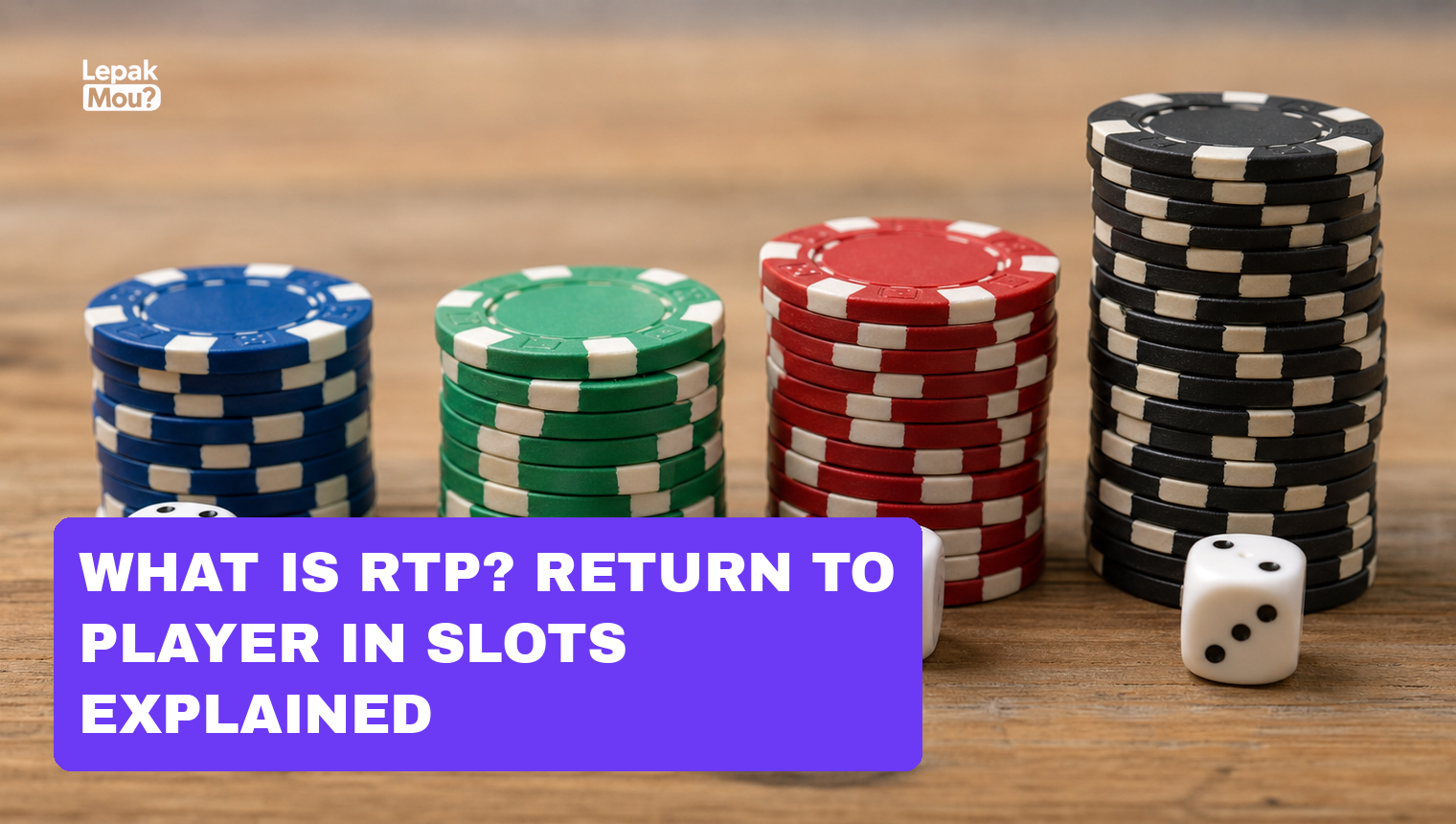
What is RTP? RTP, or return to player, is the share of all stakes that a game is designed to pay back as prizes over a very large number of plays.
This guide covers how RTP is calculated, how it connects to house edge and slot volatility, and what it means for Malaysian readers. Every example uses game units, not real money.
Note: This article is educational only and does not promote gambling. In Malaysia, casino gambling is only legal at Resorts World Genting, for visitors above 21, and Malaysian citizens must be non-Muslim.
What Is RTP in Slots and Casino Games?
The UK Gambling Commission describes RTP as the part of the money paid to play a machine that goes back to players as prizes. A slot with a 96% RTP is designed to return 96 units for every 100 units staked on it, and the other 4 units are what the operator keeps.
Wikipedia’s return to player entry uses a 90% example, where a game returns 90 of every 100 wagered. The key word is “designed”, because RTP comes from the game’s maths: what each combination pays and how likely each outcome is.
RTP is a long-run average across a huge number of plays and many players combined. It is not a prediction of what happens to one player in one evening.
Think of it like a kopitiam’s margin on each cup of kopi. It is small on one cup, but over a year it adds up to a very steady income for the shop.
In regulated markets, independent labs such as Gaming Laboratories International (GLI) test and certify electronic gaming machines. That testing is what lets players trust a published figure, but it does not change the edge built into the game.
Other Meanings of RTP
If you landed here from a different context, these are the common non-gambling meanings:
- Networking: the Real-time Transport Protocol, which carries audio and video over internet networks for things like voice and video calls.
- Chemistry: room temperature and pressure, a set of standard conditions used in gas calculations.
- Banking: real-time payments, meaning instant transfers between accounts.
The rest of this article is about the gambling meaning: return to player.
How RTP Is Calculated
The formula itself is simple:
RTP = (total amount paid back to players ÷ total amount staked) × 100
Here is a worked example in units:
- Over its life, a slot machine takes 1,000,000 units in stakes.
- Over the same period, it pays out 965,000 units in prizes.
- 965,000 ÷ 1,000,000 = 0.965.
- 0.965 × 100 = 96.5% RTP.
Game designers do not wait years to find this out. They work it out from the game’s maths, using every possible outcome and its probability.
Regulators then separate two versions of the number. The UK Gambling Commission’s key terms define theoretical RTP as the designed figure, and actual RTP as the figure calculated from a live game’s real wins and turnover.
Turnover counts every stake, including winnings that get played again. As more play builds up, the UK Gambling Commission says actual RTP should land very close to the theoretical figure.
Why One Session Won’t Match the Figure
This is where most people get confused. The UK Gambling Commission gives an 85% machine as an example and says players should not expect to win back 85 pence of every £1 during a single playing session.
Here is the same idea in units, step by step:
- Someone plays 200 spins at 1 unit each on a 96% RTP slot.
- Total staked: 200 × 1 = 200 units.
- House share: 100% − 96% = 4%.
- Expected cost: 200 × 4% = 8 units.
On paper, that session costs 8 units. In reality, the player might lose most of the 200 or come out ahead, because over 200 spins luck easily swamps a 4% edge.
Courts have noticed this gap too. Wikipedia notes that in 2018 the Federal Court of Australia found RTP information in one case misleading, because it described a long-term figure that does not apply to short-term play.
RTP vs House Edge
House edge is simply the flip side of RTP. It is the same idea, seen from the casino’s side of the table.
House edge = 100% − RTP
So a game with a 97.3% RTP has a 2.7% house edge. Here is what that means over 100 rounds at 50 units a round:
- Total staked: 50 × 100 = 5,000 units.
- At a 2.7% house edge: 5,000 × 2.7% = 135 units expected cost.
- At a 5.26% house edge: 5,000 × 5.26% = about 263 units expected cost.
Same bets and same number of rounds, but nearly double the expected cost from a different edge. That is why the figure matters.
Table games usually quote house edge, while slots usually quote RTP. Wikipedia points out that the two are mathematically identical, but framing them differently can change how players feel about the same cost.
Texas Hold’em is the odd one out, because you play against other players, not the house. The casino earns through the rake, a cut taken from the pot, so your result depends on the other players as well as the poker hand rankings.
RTP and House Edge by Casino Game
The table uses house edges published by Wizard of Odds for eight-deck baccarat and roulette, with RTP worked out as 100% minus the edge. The slot machine minimums come from Wikipedia.
| Game and bet | RTP | House edge | Notes |
|---|---|---|---|
| Baccarat: banker bet | 98.94% | 1.06% | Eight decks, after commission on banker wins |
| Baccarat: player bet | 98.76% | 1.24% | Eight decks |
| Baccarat: tie bet | 85.64% | 14.36% | Big payout, poor value |
| European roulette | 97.30% | 2.70% | Single zero wheel |
| American roulette | 94.74% | 5.26% | Most bets on a double zero wheel |
| Slot machines | Varies by machine | Varies by machine | Legal minimums include 75% in Nevada and 83% in New Jersey |
The tie bet is the clearest example of a bad bet inside an otherwise low-edge game. Its 14.36% edge is more than ten times the banker bet’s, and our baccarat guide explains how each bet works.
Roulette teaches a similar lesson. The two wheels look almost identical, but the extra double zero pocket takes the house edge from 2.70% to 5.26%.
What RTP Means for Slot Machines
A slot’s RTP is fixed by its maths, and on a regulated machine nothing you do changes it. Wikipedia notes that machines can be programmed to pay back anywhere from 0% to 99%, within whatever minimum the regulator sets.
That means two machines with the same artwork are not guaranteed to have the same RTP. The machine’s settings matter more than its theme.
On older machines, the pay table sits on the face of the machine, while video slots usually keep it in a help menu. According to Wikipedia, some game makers publish their slots’ RTP, while others do not.
Progressive jackpot slots are a special case. Part of every stake feeds the jackpot pool, so less is left for regular wins.
If you want the full picture of reels, paylines and the random number generator, read our guide on how slot machines work.
Slot Volatility: Why RTP Isn’t the Whole Story
Slot volatility, also called variance, describes how a game’s returns are spread out. The UK Gambling Commission says the standard deviation of a game is most commonly used to represent its volatility.
- Low volatility: small wins arrive often, so the balance moves up and down gently.
- High volatility: wins are rarer but bigger, so long dry spells are normal.
Picture two 96% RTP slots and a 100-unit budget at 1 unit a spin. Both have the same expected cost of 0.04 units a spin.
On the low-volatility game, frequent small wins keep topping up the balance, so the budget usually drifts down slowly. On the high-volatility game, the same 100 units can vanish in a long run of dead spins, or one big win can land early.
RTP tells you the long-run cost, while volatility tells you how bumpy the ride is and how fast a budget can disappear. High volatility is more stressful, and it burns through a budget faster when luck runs cold.
Some games label volatility in their info screen as low, medium or high. Not all games show it, so treat the label as useful but optional information.
Common RTP Myths
- “This slot is due to pay”: each spin is independent and decided by a random number generator. The New York State guide to gambling machines says machines do not adjust to a string of wins or losses.
- “Higher RTP means I’ll win”: a higher RTP only means a lower expected long-run cost. A 97% game still has a built-in edge, just a smaller one than a 94% game.
- “RTP is what I’ll get back tonight”: it is what the game returns to all players combined over an enormous number of plays. One evening can land far above or far below it.
- “Demo results show what real play will do”: free-play spins are just as subject to luck as real ones. A good demo run says nothing about the next real-money session.
RTP and the Law in Malaysia
Casino gambling in Malaysia is legal only at the casino at Resorts World Genting in Genting Highlands, Pahang. Resorts World Genting’s casino page says visitors must be above 21, and Malaysian citizens must be non-Muslim.
Online is a different story. In 2023, the Court of Appeal ruled that online gambling is an offence under the Common Gaming Houses Act 1953.
That matters for RTP too, because a high RTP advertised by an unlicensed site is not checked by any Malaysian regulator. This guide does not name or recommend any online casino.
A trip up the hill does not need the casino at all. Genting SkyWorlds has plenty of rides for a family day out.
This section is general information, not legal advice. See our editorial policy for how we research these guides.
Playing Responsibly
Every game in the table above returns less than 100%, so the maths always favours the house over time. Anyone who gambles where it is legal should treat it as paid entertainment with a fixed budget, never as a way to make money.
- Set limits first: decide a budget and a time limit before you start, and stop when either is reached.
- Never chase losses: trying to win money back is how small losses turn into big ones.
- Don’t borrow to gamble: not from a bank, a credit card or friends.
- Take regular breaks: and keep track of what you have actually spent.
Gambling problems often show up in money and relationships first: hidden spending, borrowing and unpaid bills. Our guide to financial red flags covers how these patterns can strain a relationship.
Resorts World Genting runs a Responsible Gaming programme with self-exclusion options and a 24-hour hotline on +603-6105 9557. If gambling is affecting your life, Befrienders KL offers free, confidential emotional support on its 24-hour line, +603-7627 2929.
The Bottom Line on RTP
RTP is the share of all stakes a game is designed to pay back over a huge number of plays, not one evening. House edge is its mirror image, and volatility decides how bumpy the ride is along the way.
Knowing these numbers helps you compare the expected cost of different games, but no figure turns gambling into a way to earn money. For fun with no money on the line, try these Malaysian card game favourites or learn how to play mahjong.